

Hardwood floors are one of the most valuable features in a San Francisco or Marin County home — and one of the most commonly damaged by incorrect cleaning. The mistakes are almost always the same: too much water, the wrong products, or the wrong tools. A floor that took decades to develop its patina can be permanently damaged in a single cleaning session.
This guide covers the correct method for cleaning hardwood floors by type, the products that protect versus damage, the tools that work versus those that cause scratches, and a maintenance schedule that keeps floors looking their best year after year.
Find the Right Method for Your Floor Type
Recommended Cleaner
pH-neutral hardwood cleaner (Bona Hardwood)
Cleaning Frequency
Weekly sweep, monthly mop
Avoid These Products/Methods
Vinegar, steam mops, excess water
Notes for Bay Area Homes
Original floors in SF Victorians — most sensitive to moisture
The Correct Method: Step by Step
Dry sweep or dust mop first — always
Never mop a floor that hasn't been swept first. Grit and sand particles act like sandpaper under a mop head, creating micro-scratches that dull the finish over time. Use a microfiber dust mop rather than a broom — brooms push fine dust into the air rather than capturing it. Sweep in the direction of the wood grain.
Vacuum with a hard floor setting
For a more thorough clean before mopping, vacuum with the beater bar turned off (or use a hard floor attachment). The beater bar on most vacuums will scratch hardwood. Use a vacuum with a felt or rubber floor head. Pay attention to gaps between boards where dust and debris accumulate.
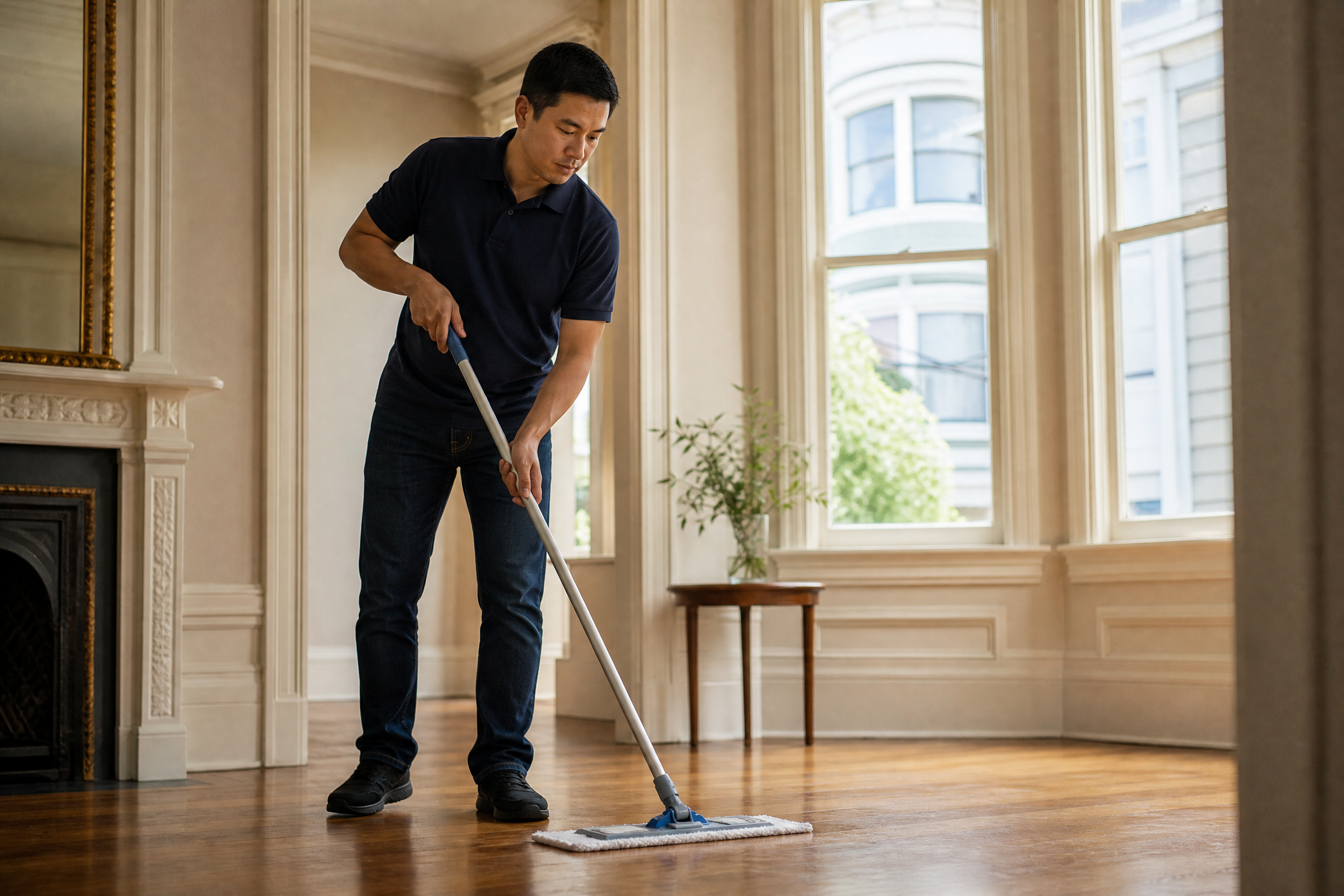
Use a barely damp mop — not a wet mop
This is the most important rule in hardwood floor cleaning. Wring your mop until it's barely damp — you should be able to hold it against your arm without feeling wetness. Excess water seeps between boards, causes swelling, and eventually leads to warping and cupping. For spray mops, use one or two sprays per section, not continuous spraying.
Use the right cleaner for your floor type
Use a pH-neutral hardwood floor cleaner — Bona Hardwood Floor Cleaner is the industry standard. Avoid vinegar (acidic — strips finish over time), Murphy Oil Soap (leaves a residue that dulls the finish), and any cleaner not specifically formulated for hardwood. Dilute according to instructions — more product is not better.
Mop in the direction of the wood grain
Mopping against the grain pushes dirty water into the gaps between boards. Work from the farthest corner toward the door so you don't walk on the wet floor. Work in sections of 4–6 feet at a time.
Dry immediately if needed
In San Francisco and Marin County's humid climate, floors dry more slowly than in drier regions. If you used a slightly wetter mop than intended, dry the floor immediately with a clean microfiber cloth or a dry mop head. Never let water sit on hardwood.
Products That Damage Hardwood Floors
The most common hardwood floor damage in San Francisco homes isn't from foot traffic — it's from incorrect cleaning products. These are the products that professional cleaners never use on hardwood.
White vinegar
Strips the polyurethane finish over time. Vinegar is acidic (pH 2–3) and breaks down the protective coating on hardwood. Many DIY cleaning guides recommend vinegar — they're wrong for hardwood floors.
Steam mops
Force steam into the wood grain and between boards, causing swelling, warping, and cupping. Void most hardwood floor warranties. Never use on hardwood regardless of what the steam mop manufacturer claims.
Murphy Oil Soap
Leaves a waxy residue that builds up over time and dulls the finish. Requires professional stripping to remove. Very popular — and very wrong for modern polyurethane-finished hardwood.
Bleach or ammonia-based cleaners
Discolor and strip the finish. Can permanently lighten or streak hardwood if used at full strength.
Wet Swiffer refills (the wet ones)
Too much moisture for hardwood. The dry Swiffer sweeper is fine; the WetJet is not recommended for hardwood.
All-purpose spray cleaners
Most are too alkaline or contain solvents that attack the finish. Use only hardwood-specific cleaners.
Hardwood Floor Maintenance Calendar
| Frequency | Task | Time Required |
|---|---|---|
| Daily | Dry sweep high-traffic areas | 2–3 min |
| Weekly | Full dust mop of all hardwood areas | 10–15 min |
| Weekly | Spot clean spills and marks immediately | As needed |
| Monthly | Damp mop with hardwood cleaner | 20–30 min |
| Quarterly | Inspect for scratches, dull areas, and loose boards | 15 min |
| Annually | Apply hardwood floor refresher/polish | 1–2 hours |
| Every 5–10 years | Professional refinishing (sand and recoat) | 2–3 days |
Frequently Asked Questions
Can I use a Swiffer WetJet on hardwood floors?
No. The WetJet dispenses too much moisture for hardwood floors. The dry Swiffer sweeper is fine for daily dust removal. For mopping, use a microfiber mop with a hardwood-specific cleaner, wrung until barely damp.
How do I remove scratches from hardwood floors?
For light surface scratches, a hardwood floor touch-up marker or crayon in a matching color fills the scratch. For deeper scratches, a wood filler product works well. For widespread scratching or deep gouges, professional sanding and refinishing is the only permanent solution.
Why do my hardwood floors look dull after cleaning?
Dull floors after cleaning usually mean product residue buildup. Murphy Oil Soap, vinegar, and many all-purpose cleaners leave residue that accumulates over time. Use a hardwood floor cleaner specifically designed to clean without leaving residue (Bona is the most widely recommended). For existing buildup, a hardwood floor refresher can restore shine.
How often should hardwood floors be professionally cleaned?
Professional hardwood floor cleaning (as part of a full home clean) is recommended every 2–4 weeks for maintained floors. For a deep clean that addresses buildup in gaps and corners, quarterly professional cleaning is ideal.
Are hardwood floors harder to maintain with pets?
Yes — pet nails cause scratches, and pet accidents can permanently stain and warp hardwood if not addressed immediately. Trim pet nails regularly, use area rugs in high-traffic pet areas, and clean accidents immediately with an enzyme cleaner followed by a dry cloth.
What's the best way to protect hardwood floors in a San Francisco Victorian?
Victorian hardwood floors are often original and irreplaceable. Use felt pads under all furniture legs, place rugs at all entryways, remove shoes at the door, and use a pH-neutral hardwood cleaner exclusively. Refinish every 7–10 years to maintain the protective polyurethane coating.
Can I mop hardwood floors with just water?
Plain water is slightly acidic (pH 6–7) and can still damage hardwood finish over time. More importantly, water alone doesn't clean effectively — it just moves dirt around. Use a hardwood-specific cleaner diluted according to instructions, applied with a barely damp mop.
Professional Hardwood Floor Cleaning in San Francisco & Marin
Green Planet Cleaning uses only pH-neutral, hardwood-safe products on all floors. Our teams are trained on the specific needs of Victorian and Craftsman hardwood floors across the Bay Area.
Get a Free Estimate