

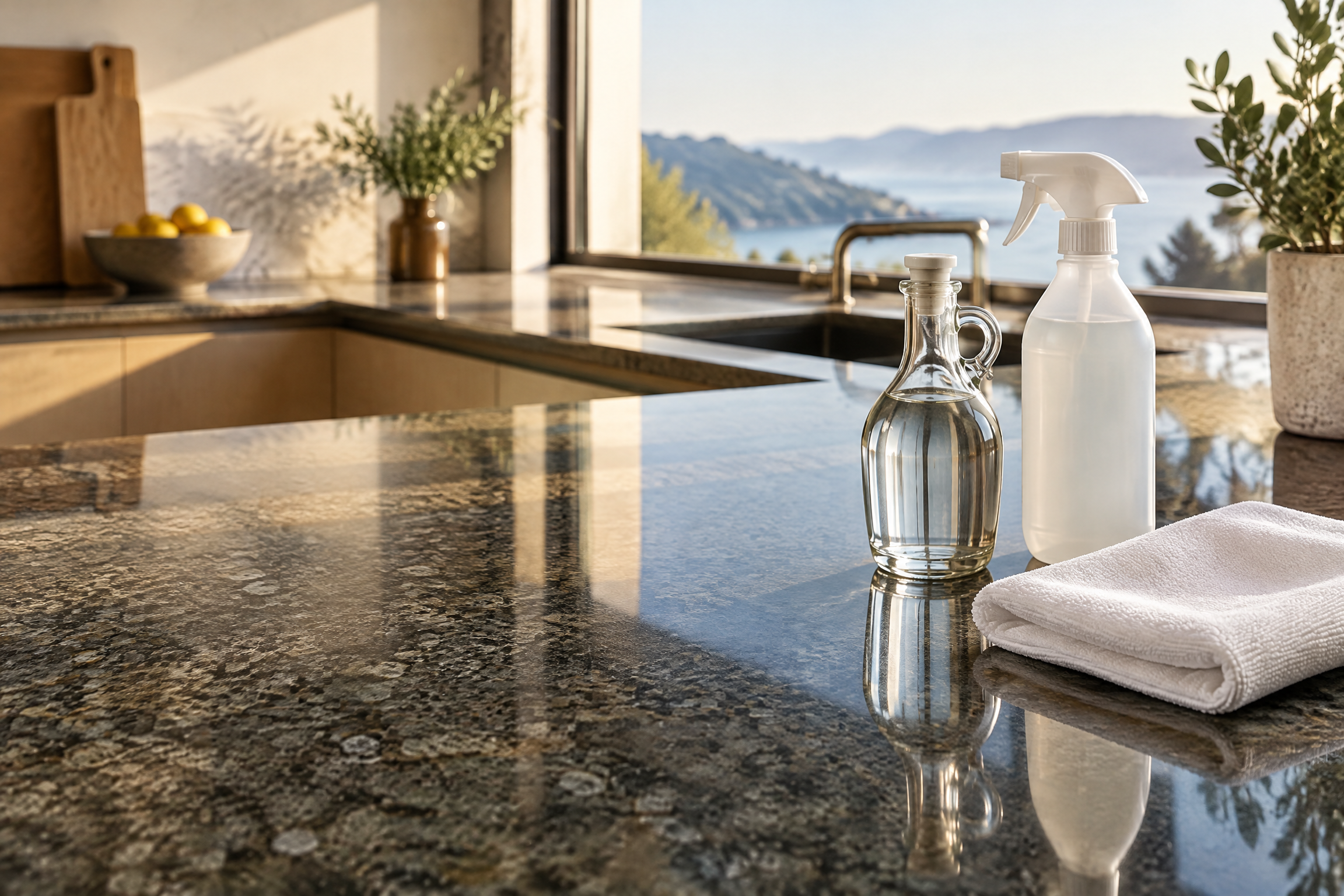
No—do not use vinegar as a routine cleaner on a granite countertop. Vinegar is acidic, while reliable stone-care guidance favors a neutral cleaner, stone soap, or a mild liquid dishwashing detergent with warm water for natural stone. Granite is often a tough, silicate-rich material, but that does not turn a kitchen counter into a good place for a homemade acid cleaner. Its mineral mix, finish, grout, seams, and protective treatment can all vary from one installation to the next.
That distinction matters when a popular cleaning shortcut is involved. A diluted vinegar solution may be suggested for other household surfaces, yet it is not the sensible default for granite. The lower-risk approach is simple: remove crumbs and spills promptly, clean with a soft cloth and a product approved for the installed surface, rinse away any cleaner residue as directed, and dry the counter. This guide explains why that routine is more protective than vinegar, what to use instead, and what to do if vinegar has already touched the stone.
Practical note: Choose the method for the actual surface, read the product and manufacturer instructions, and test a discreet area whenever a finish is uncertain.
The short answer: keep vinegar off granite countertops
Treat vinegar as a no for everyday granite care—even when it has been diluted with water. Natural-stone care authorities advise against acidic cleaners on stone because the response depends on the stone’s composition. Granite is generally siliceous and may resist many kitchen acids better than calcium-carbonate stones, but it can contain trace minerals that are acid sensitive. A countertop is also more than its visible slab: it may have an impregnating treatment, resin-filled areas, seams, edge profiles, and nearby grout or backsplash materials with their own care limits.
The practical question is not whether one quick vinegar wipe will visibly ruin every granite counter. It is whether vinegar offers an advantage worth introducing an avoidable variable to an expensive, finished surface. It does not. A neutral, stone-appropriate cleaner handles ordinary kitchen soil without relying on acid, and the countertop fabricator or surface manufacturer is the right authority when the material, finish, or treatment is uncertain.
Do not assume a dark, polished, honed, leathered, sealed, or newly installed counter has the same tolerance as another slab labeled granite. Confirm the care instructions that came with the countertop before trying a new cleaner, especially on a matte or textured finish where a change in sheen may be more noticeable.
- Skip white vinegar, cleaning vinegar, lemon juice, citrus-based acidic cleaners, and homemade acid mixtures unless the countertop manufacturer specifically authorizes them for that exact surface.
- Do not use a vinegar-and-water mixture as a regular granite spray simply because dilution makes it milder; it is still an acidic cleaner.
- Check the label on ready-made cleaners rather than relying only on the front-of-bottle marketing. Choose one identified for natural stone or confirmed by the countertop maker.
Why vinegar is a poor match for granite care
Vinegar’s cleaning reputation comes from its acidity. That property can be useful on some surfaces and deposits, but it is precisely why it is not a universal countertop cleaner. Natural stone is not a single material category with one reaction to every product. The stone’s particular minerals and finish influence what it tolerates, and manufacturers’ care directions are designed around the installed material rather than a generic kitchen-cleaning rule.
Acid exposure can dull or etch acid-sensitive stone, and natural-stone guidance notes that acids may affect minerals within otherwise siliceous stone. Even if the granite itself appears unchanged after one use, the cleaner may be a poor choice for a protective treatment or adjacent material. An impregnating treatment is intended to improve stain resistance; it does not make a surface stain-proof or grant permission to ignore the specified maintenance routine.
There is another reason not to improvise: a countertop’s appearance is made up of its finish as well as its color. A polished surface, a honed surface, and a textured surface reflect light differently. Repeated use of an unapproved cleaner can make it harder to tell whether a cloudy area is cleaner residue, a change in finish, or an issue needing professional evaluation. Starting with a compatible cleaner avoids turning routine maintenance into diagnosis.
A simple, low-risk daily routine for granite
For ordinary crumbs, fingerprints, cooking splatter, and light soil, begin with the least aggressive method. Clear loose debris so it cannot be dragged across the counter. Wipe the surface with a clean, soft cloth dampened with warm water and a small amount of an appropriate neutral cleaner, stone soap, or mild liquid dishwashing detergent if the surface guidance allows it. Use only enough solution to clean the area; overconcentrated soap can leave a film or streaks.
Follow the cleaner label and the countertop maker’s directions about dwell time, rinsing, and drying. If a soap solution is used, rinse thoroughly with clean water and dry with a soft cloth rather than allowing standing water or cleaner to air-dry. A dry finish is not just cosmetic: it makes residue and missed spills easier to see before the next meal preparation.
For a sticky patch, use a little more time rather than a stronger chemical. Hold the damp cloth on the residue briefly if the product directions permit, then lift it away with gentle wipes. A plastic scraper used carefully and only when the surface maker allows it may be appropriate for dried-on material; avoid metal tools and abrasive pads. When in doubt, stop and ask the fabricator, especially near seams, repaired spots, or delicate edge details.
- Use soft, clean microfiber or another nonabrasive cloth; retire a cloth if it has picked up grit.
- Work from clean areas toward the spill rather than spreading residue across the whole counter.
- Rinse and dry after soap-based cleaning so leftover cleaner is not mistaken for haze or dullness.
- Use trivets or mats for hot cookware and coasters for drinks, following the countertop maker’s guidance for the installation.
Granite countertop action planner
Match the response to the situation instead of using vinegar as a catch-all cleaner. When the countertop maker gives different directions for your specific material or finish, its instructions take priority.
| Situation | First response | What to avoid | When to escalate |
|---|---|---|---|
| Daily crumbs and light fingerprints | Remove debris; wipe with a soft cloth and a compatible neutral cleaner or approved mild soap solution; rinse and dry as directed. | Vinegar sprays, abrasive scrubbers, and excess soap that can leave a film. | If a normal approved cleaning repeatedly leaves haze, confirm the product and dilution with the fabricator. |
| Fresh food or drink spill | Blot immediately, then clean gently with water and a surface-approved method; dry thoroughly. | Scrubbing outward, letting the spill sit, or applying a stronger cleaner without knowing the spill and surface requirements. | If color, oiliness, or a ring remains after the approved routine, ask a stone professional for material-specific stain advice. |
| Sticky or dried-on residue | Use patience, a soft damp cloth, and only a manufacturer-approved approach; ask before using a plastic scraper. | Metal blades, scouring powder, or acid meant to dissolve the residue. | If residue is bonded, near a seam, or resists approved cleaning, contact the fabricator or a qualified stone-care professional. |
| Vinegar was used once | Remove remaining product with clean water as directed and dry with a soft cloth; inspect in normal light. | Trying to neutralize it with another cleaner, repeated testing, or aggressive buffing. | If there is persistent haze, a change in sheen, roughness, or a visible mark, document the product and seek professional evaluation. |
| Unknown counter material or finish | Pause, locate the care documents, and confirm whether the surface is natural granite and how it should be cleaned. | Assuming it is granite or borrowing care instructions from quartz, marble, tile, or another surface. | Contact the seller, installer, fabricator, or manufacturer before using a new cleaner or a stain-removal method. |
Respond to spills and kitchen messes without reaching for vinegar
Speed and restraint are more helpful than an all-purpose remedy. When coffee, wine, oil, juice, sauce, or another spill lands on granite, blot it promptly with a paper towel or clean absorbent cloth. Do not scrub or wipe outward, which can spread the spill into a larger area. Then clean the spot with water and an approved mild cleaner, rinse as appropriate, and dry it. The exact response should follow the stone supplier’s care instructions, particularly when the spill is oily, colored, or has been sitting for a while.
Stains and etches are not the same thing. A stain changes the stone’s appearance because material has entered or remained on the surface; an etch is a change to the finish caused by an acidic substance. Granite can be more acid resistant than some natural stones, but visual diagnosis from a photo or a household test is unreliable. Avoid escalating from a spot to vinegar, bleach, ammonia, a scouring powder, or a toilet-bowl product. Those shortcuts can create a larger issue or introduce ingredients unsuitable for stone.
If ordinary cleaning does not resolve a mark, identify what likely caused it and contact the fabricator, stone supplier, or a qualified stone-restoration professional for material-specific advice. This is especially important for a persistent dull patch, a roughened area, a ring, a crack, or a mark around a seam. Keep the product container or a photo of its ingredients so the professional has useful information.
Choose granite cleaners by compatibility, not by a viral recipe
A compatible cleaner is not defined by a homemade ingredient list or a broad label such as “all-purpose.” Start with the countertop manufacturer’s or fabricator’s care guide. If it permits a ready-made product, look for a product intended for natural stone or a neutral cleaner, and use it exactly as labeled. If it permits mild liquid dishwashing detergent, use a modest amount in warm water and do not assume more detergent will clean better.
Avoid products that are acidic, highly alkaline, or abrasive unless the stone professional responsible for your counter directs you otherwise. Natural-stone guidance specifically warns about lemon, vinegar, and other acids; scouring powders or creams can contain abrasives that may scratch stone. It also notes that products containing hydrofluoric acid can attack all stones, including granite and quartzite. Read both the active-ingredient panel and the usage warnings before a new product touches the countertop.
Do not mix cleaners to make a stronger solution. In particular, never mix ammonia and bleach; the combination can create a toxic gas. Product labels and the stone maker’s instructions should decide the method—not a social-media cleaning formula. When a label conflicts with the surface manufacturer’s instruction, pause and contact the surface manufacturer or fabricator for clarification.
- Best starting point: the care document for the exact countertop material and finish.
- Routine option: a neutral, stone-appropriate cleaner used as directed, with a soft cloth.
- Conditional option: a mild liquid dishwashing detergent and warm water only when allowed by the surface guidance, followed by a thorough rinse and soft dry.
- Avoid: acidic, abrasive, or unverified cleaners; products intended for toilets, rust, drains, or heavy industrial deposits do not belong in routine granite care.
If you already used vinegar on granite, take a measured next step
Do not panic and do not try to counteract vinegar with another household chemical. If vinegar has just been used, remove it with clean water in accordance with the countertop maker’s guidance, then dry the surface with a soft cloth. Do not keep rubbing a visible area in an attempt to polish it away. Aggressive scrubbing can add wear, and applying additional products makes it harder to understand what changed.
Next, inspect the counter in ordinary daylight from more than one angle. Look for a change in sheen, a cloudy or dull patch, a color change, or residue that persists after a normal approved cleaning. If nothing appears different after a one-time, quickly removed exposure, return to the approved routine and discontinue vinegar. Avoid “testing” the spot again or applying vinegar elsewhere to compare it.
If a mark, rough texture, or loss of polish remains, contact the countertop fabricator, stone supplier, or qualified stone-restoration professional. Share the product used, whether it was diluted, how long it sat on the surface, and what steps have already been taken. That information lets the professional recommend an appropriate evaluation rather than a trial-and-error treatment. Re-sealing, refinishing, or repolishing decisions should be made for the particular stone and finish, not as a blanket response to every counter.
Build granite-safe habits into a professional home cleaning plan
A well-kept granite counter is easier to maintain when its care rules are visible and consistent. Leave the manufacturer-approved product available, store acidic pantry ingredients away from the cleaning caddy, and tell anyone cleaning the kitchen which surfaces are natural stone. For recurring help, point out the countertop material, finish, seams, and any fabricator instructions before service begins. Clear product guidance is more useful than asking someone to use the “strongest” cleaner.
If your kitchen needs routine attention without guesswork, explore professional home cleaning and share your countertop care instructions when arranging service. A practical plan can focus on ordinary soil removal with the products and methods appropriate to your installed surfaces. For unusual stains, damage, or a finish concern, schedule an assessment with the fabricator or stone-care specialist rather than treating it as a standard cleaning task.
The lasting takeaway is uncomplicated: vinegar is not a default granite cleaner. Use gentle, compatible maintenance; blot spills promptly; avoid abrasive and acidic shortcuts; and let the countertop manufacturer’s directions lead whenever the stone’s make-up or treatment is unknown.
- Keep the countertop care sheet with other appliance and home-maintenance records.
- Label stone-safe supplies so an all-purpose spray is not used by mistake.
- Raise persistent stains, haze, chips, cracks, or seam changes with the appropriate stone professional before attempting a repair.
Plan around the whole countertop, not only the visible slab
Granite care often goes wrong when the routine is chosen for the center of the counter but not for the entire installation. A kitchen can include a backsplash, grout, caulked seams, an undermount sink edge, a cooktop cutout, a drainboard, and cabinetry immediately below the stone. Each of those details may have a different care limit. Before trying a new product, look at where it could run, collect, or be splashed. A spray that seems harmless on the horizontal slab may be unsuitable for a seam, a nearby painted surface, or a porous grout line.
Build the daily routine around a small, repeatable sequence rather than a cabinet full of specialty bottles. Keep a clean microfiber cloth for the counter, a separate cloth for the sink, and the approved cleaner or mild-soap method that the care guide permits. Wipe after food preparation, rinse away any soap film when the instructions call for it, and dry the counter. This modest routine is usually easier to follow than waiting for a buildup and then reaching for a stronger product. It also gives you a clearer baseline for noticing a new mark or change in sheen.
For households with multiple people, guests, or a cleaning service, the most useful instruction is specific: name the material, point out the approved product, and explain what not to use. ‘Natural stone—no vinegar or abrasive pads’ is more actionable than simply asking someone to be careful. Put the care sheet where it can be found, retain a photo of the fabricator’s instructions, and revisit the plan when a new countertop product is purchased. That protects the finish without turning normal kitchen upkeep into an overly complicated project.
- Treat sinks, seams, grout, backsplash material, and countertop edges as separate surfaces until their care directions are confirmed.
- Apply a cleaner to the cloth when appropriate rather than broadly spraying near seams, walls, outlets, or appliance controls.
- Keep one clear, manufacturer-approved routine visible for anyone who helps maintain the kitchen.
- Record changes in sheen, texture, or color before attempting a second product or a repair method.
Frequently asked questions
Can you use diluted vinegar on granite?
It is better not to use diluted vinegar for routine granite cleaning. Dilution lowers the concentration but does not make vinegar a neutral cleaner. Granite varies by mineral composition and finish, and the counter may have an impregnating treatment, seams, or nearby materials with different care limits. Choose a neutral cleaner or stone-care product that the countertop manufacturer or fabricator approves instead.
What is the safest everyday cleaner for granite countertops?
Follow the countertop manufacturer’s instructions first. Natural-stone care guidance commonly recommends a neutral cleaner, stone soap, or a mild liquid dishwashing detergent with warm water. Use a soft, clean cloth, avoid overconcentrating soap, rinse thoroughly when a soap solution is used, and dry with a soft cloth. A product specifically intended for natural stone may be an option when its label and your surface guidance agree.
Will one use of vinegar ruin granite?
A one-time use does not automatically mean visible damage on every granite countertop, so there is no need to panic. Remove any remaining vinegar with clean water as directed for the surface, dry the area, and do not add another chemical to compensate. If you notice a persistent dull patch, haze, altered sheen, roughness, or color change, contact the fabricator, stone supplier, or a qualified stone-restoration professional with the product details.
Can I use vinegar to remove hard-water marks or soap scum on granite?
Do not treat vinegar as the default solution for hard-water marks or soap scum on granite. The mark may be mineral residue, cleaner film, an issue with the finish, or something else, and an acidic shortcut may not be compatible with the exact stone or treatment. Consult the countertop manufacturer’s care guide for an approved method. If the mark persists, seek advice from the fabricator or a stone-care professional rather than experimenting with stronger acids or abrasive products.
Does sealing make granite safe to clean with vinegar?
No. An impregnating treatment can help a stone resist staining, but it does not make the countertop stain-proof or override its care instructions. A sealer is not a blanket permission to use acidic cleaners. Ask the fabricator or sealer manufacturer which products are compatible with the specific stone and treatment, and follow its recommendations for maintenance and any future reapplication.
Need help with the next step? Explore professional home cleaning or request a flat-fee estimate for your home.
Let Green Planet Handle the Cleaning
Family-owned since 2010. 100% eco-friendly. Greentified™ Guarantee — if you're not happy, we re-clean for free within 24 hours.
Serving Marin County, San Francisco, Sonoma, Napa, San Mateo & Contra Costa.