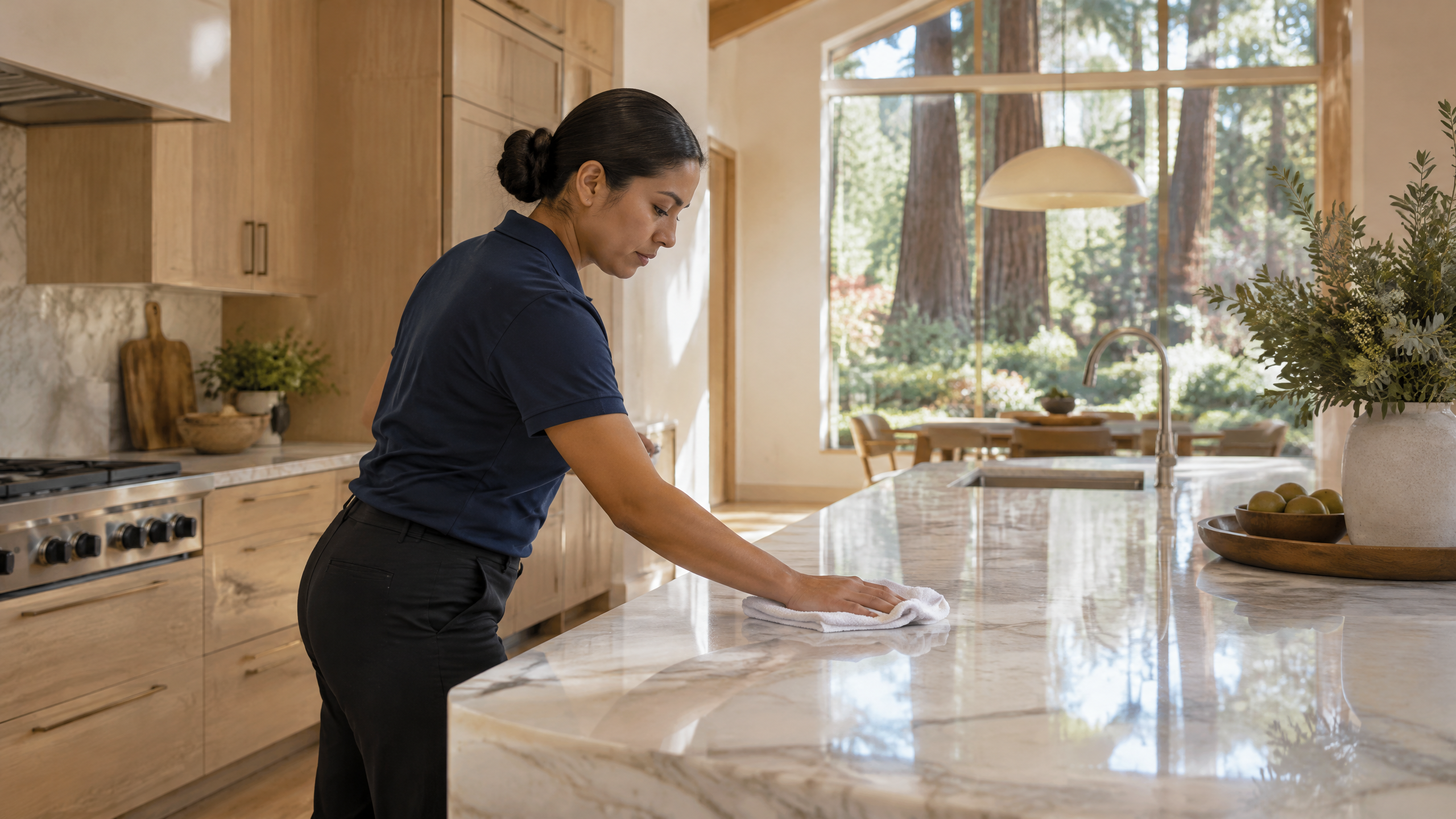


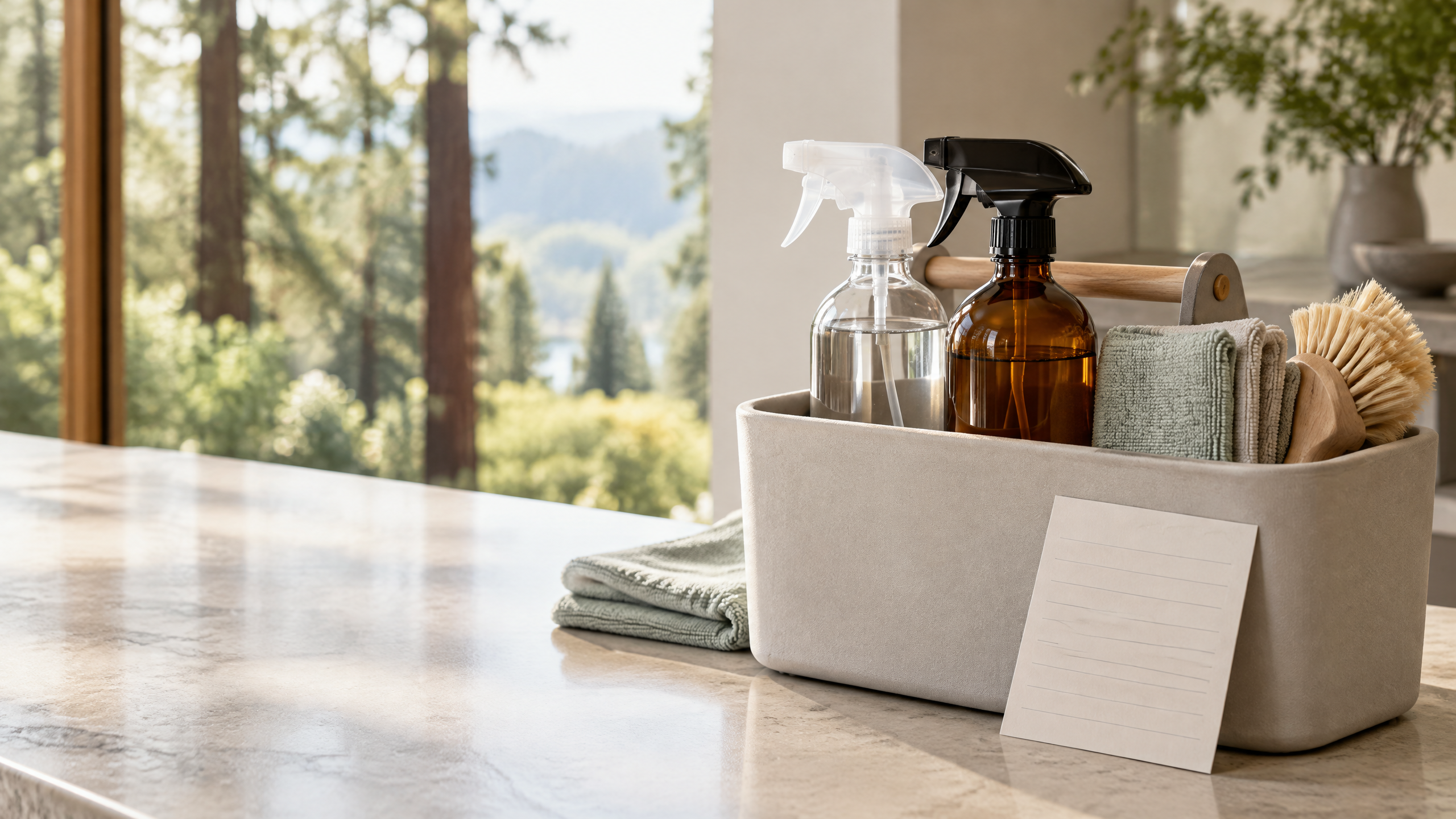
A large home does not become easier to maintain simply because it has more rooms. It becomes a small operating system: a kitchen that resets several times a day, bathrooms that collect evidence of morning and evening routines, guest spaces that may sit quiet until they do not, and circulation areas that connect all of it. In Mill Valley, many homes also move between indoor life and patios, decks, entries, and views toward surrounding trees or hills. The useful question is not whether every room should receive the same attention at every visit. It is how a recurring plan can keep the lived-in parts of the house reliably ready while rotating deeper attention through the rest.
That is the purpose of a recurring-service plan. It turns cleaning from a last-minute event into an agreed rhythm with a visible order of operations. A good plan names the rooms that matter most, the surfaces that require a lighter touch, the access details that can slow a visit, and the decisions that should be made by the household rather than guessed by the team. Start with the local service context, then shape it around the way the house is actually used: recurring large-home cleaning in Mill Valley is most useful when it is planned as a repeatable household routine, not as a generic checklist.
This guide is for homeowners, household managers, and busy families planning ongoing care for a larger Mill Valley residence. It compares weekly and biweekly rhythms, explains how to sequence a substantial home without losing sight of daily priorities, and offers a handoff method that gives each visit a clear starting point. The aim is calm and practical: fewer decisions on cleaning day, clearer expectations before arrival, and a home that is maintained in proportion to how it is lived in.
Practical note: Choose the method for the actual surface, follow product and manufacturer instructions, and test a discreet area whenever a finish is uncertain.
1. Begin with the operating map, not the bedroom count
Bedroom and bathroom counts are useful starting signals, but they do not explain the real scope of a large home. A four-bedroom house with one concentrated family routine can move very differently from a four-bedroom house with a separate office wing, a frequently used guest suite, multiple stair runs, several entertaining zones, and a kitchen that is active from early morning through dinner. Before selecting a rhythm, make an operating map: list the rooms people use every day, those used weekly, those reserved for guests, and the rooms that are mostly closed between seasons or visits.
Mark the moments that create the most visible reset work. Common examples include breakfast and school departures in the kitchen, pet or shoe traffic at the entry, afternoon work in a study, evening use of a primary bathroom, and hosting in a dining or outdoor-adjacent living area. A plan for a larger property should follow these patterns. If the breakfast kitchen and powder room are the household's daily pressure points, they deserve dependable attention even when a formal room is placed on a rotation.
The map should also identify transitions: front entry to main living floor, garage to mudroom, stair landing to bedrooms, kitchen to dining room, and interior doors to decks or garden paths. These are the areas that make a home look unsettled first. Treating them as named priorities makes a recurring service easier to review. It also prevents the mistaken assumption that every square foot has the same level of use or the same maintenance need.
- Create four labels for each room: daily use, weekly use, guest use, or low use.
- Identify two or three visual pressure points where clutter, crumbs, water marks, or traffic appear first.
- Note every level, stair run, secondary entry, office, gym, lounge, and outdoor-facing threshold that belongs in the visit plan.
- Decide which closed rooms should receive light checks and which should be deliberately scheduled for periodic attention.
2. Choose weekly when the home needs a dependable reset
Weekly service is usually a fit when the house generates visible work faster than the household wants to absorb it between visits. This can come from a full-time family routine, frequent cooking, pets, regular hosting, several people working from home, or simply a preference for kitchens and bathrooms to return to order every week. In a larger home, the weekly value is often less about making every guest room look newly prepared and more about keeping the high-use core from becoming a backlog.
A weekly rhythm gives the plan room to repeat the essentials without postponing the details that preserve a sense of readiness. High-touch kitchen and bathroom surfaces, floors in active zones, entries, stairs, living areas, and waste areas can have a consistent place in the sequence. Less-used rooms can then receive a sensible rotation rather than being ignored indefinitely. The household benefits from smaller, more predictable resets; the visit team benefits from an established order and fewer surprises.
Weekly does not mean that the house must be used heavily in every room. It means the household wants a reliable baseline. For example, a guest suite may need only a visual check and a light dusting when unoccupied, while the main suite, kitchen, and family room remain recurring priorities. Describe that distinction before the first visit. It creates an honest plan that directs attention where it changes daily life.
- Choose weekly when kitchen, primary bathrooms, entries, and shared living areas lose their reset feeling within a week.
- Use a weekly plan to protect the main floor and everyday bedrooms while rotating formal, guest, or lower-use rooms.
- Keep the recurring list stable for several visits before changing it; consistency makes gaps easier to spot.
- Reserve brief notes for exceptions, such as a guest arrival, a temporarily closed room, or an event after the next visit.
3. Choose biweekly when the household can maintain the interval
Biweekly service can work well for a large Mill Valley home when occupancy is lighter, the household already handles small daily resets, or the home has clearly separable zones. The decision should be based on what happens in the fourteen days between visits, not on an idea that a quieter-looking home automatically needs less planning. Two weeks is enough time for kitchen use, bathroom routines, dust, entry traffic, and neglected corners to accumulate in ways that change the pace of the next visit.
The practical test is simple: can the household keep the most visible areas workable without using the biweekly visit as a rescue operation? If dishes, laundry, papers, personal items, or event remnants routinely occupy the work surfaces, the visit begins with a handoff problem instead of a cleaning sequence. A biweekly plan can still be right, but it may need a clearer pre-visit reset or a narrower definition of what is ready to be maintained.
For many households, biweekly service is most effective with a defined emphasis. One visit may give a little more time to the primary suite and upper floor; the next may focus on guest-ready spaces, office areas, or the dining zone. The essential rooms still receive attention at every visit, but the rotating emphasis avoids asking one appointment to carry every deep-detail task at once.
- Choose biweekly when daily-use zones remain manageable and the household can clear surfaces before each visit.
- Set a rotation so guest rooms, offices, secondary bathrooms, and less-used living areas do not become invisible.
- Use the day before the visit for decisions, not cleaning: identify access changes, guests, and rooms to skip or emphasize.
- Reassess after several cycles if the home repeatedly needs a catch-up effort before the appointment.
A practical rhythm and handoff planner
Use this comparison as a planning conversation, not as a fixed formula. The appropriate rhythm depends on how the house is used, how the household manages the interval between visits, and which spaces need to feel reliably ready. Each row assumes that access, sensitive surfaces, and exceptions have already been made clear.
| Plan | Often useful when | Core sequence | Rotation and handoff notes |
|---|---|---|---|
| Weekly recurring | Daily family life, regular cooking, pets, frequent visitors, or a strong preference for a reliable reset in high-use areas. | Kitchen, primary bathrooms, powder room, entries, main living spaces, active bedrooms, stairs, and main traffic paths. | Rotate guest rooms, offices, formal areas, and secondary bathrooms. Send only exceptions before each visit; keep routine priorities in the standing plan. |
| Biweekly recurring | Lighter occupancy or a household that can keep surfaces and walkways ready between visits without turning the appointment into catch-up work. | Maintain the everyday core at each visit, then assign a defined secondary zone for added attention. | Use a day-before note to confirm guests, rooms to skip, access changes, and the next rotating emphasis. Reassess if the interval repeatedly creates a backlog. |
| First-visit reset before recurrence | The home has been between routines, has hosted recently, has accumulated work in low-use rooms, or needs the baseline clarified. | Establish the starting condition in priority zones, then decide what belongs in the regular sequence going forward. | Describe condition, bathrooms, levels, entries, and delicate surfaces accurately. Keep organization or post-project work distinct from routine maintenance. |
| Hosting or guest-ready emphasis | An arrival, dinner, or gathering changes which rooms need to be ready on a particular visit. | Protect the usual core, then prioritize guest path, powder room, dining area, guest suite, and arrival-facing rooms as agreed. | Provide the date and the rooms that matter most. If the change is substantial, discuss it as a scope adjustment rather than assuming it fits the normal visit. |
| Lower-use wing rotation | The property has separate bedrooms, a lower level, offices, or rooms that should not be neglected but do not need the same attention every visit. | Complete the active-zone baseline first, then address one named low-use zone according to the rotation. | Record simple surface rules and whether a room is occupied, closed, or guest-ready. Periodic checks are more reliable than vague intentions. |
4. Sequence rooms by use, access, and reset value
In a substantial house, a room-by-room march is not always the most effective sequence. The better order combines three factors: how much a space is used, how it connects to the rest of the home, and how much its reset changes the way the house feels. The kitchen, primary bathrooms, powder room, entry, and main living area often belong near the top because they are both visible and frequently used. Bedrooms and private offices may follow according to occupancy and agreed priorities.
Think in zones rather than in isolated rooms. A main-floor zone may include the entry, powder room, kitchen, breakfast area, family room, and the passageways between them. An upstairs zone may include the primary suite, hall bath, laundry-adjacent corridor, and occupied bedrooms. A guest zone may include a bedroom, bath, sitting room, and the route a visitor takes from the entry. This approach reduces backtracking and makes it easier to see whether an entire experience of the home has been reset.
Sequencing should account for the household's schedule. If someone needs a home office during a particular window, state that clearly. If a child is napping, a bedroom wing may need to be visited later. If tradespeople, deliveries, or gardeners are expected, note the entry or area that may be affected. These are not fussy details; they are the information that turns a general list into a working plan.
- Name the priority zone that must look and function ready by the end of every visit.
- Group adjacent rooms and circulation paths so the plan follows how people move through the property.
- Schedule private workspaces, bedrooms, and quiet zones around household routines when practical.
- Use a rotating secondary zone to bring periodic attention to rooms that are important but not used daily.
5. Give delicate surfaces their own instructions
Large Mill Valley homes can combine warm wood, stone, painted finishes, metal fixtures, glass, and custom cabinetry in one visual field. Surface care should not be left to inference. A recurring plan is stronger when the household identifies what is delicate, what has a manufacturer instruction, what should be avoided, and what supplies must remain in the home. Natural stone, unsealed or specialty finishes, antique pieces, hand-painted surfaces, and certain metals can require a specific method or a lighter touch.
Create a surface note that is short enough to be useful: location, material, instruction, and restriction. For example: primary bath vanity, natural stone, follow the care directions kept in the drawer; dining credenza, antique finish, dry dust only; kitchen island, wood surface, use the household-approved method. The purpose is not to turn a cleaning day into a conservation project. It is to prevent ordinary recurring work from relying on assumptions.
Small physical cues can help. Store approved materials together when possible, label products that are intended for a particular surface, and let the team know if an item has recently been refinished or sealed. If the homeowner is unsure about a material, it is better to pause that request and obtain appropriate care guidance than to frame it as a standard recurring task. The same principle applies to high or difficult-to-reach architectural features: identify the priority, the access condition, and whether it belongs in the regular rotation.
- List stone, wood, antique, painted, metal, and specialty surfaces separately from routine rooms.
- Keep manufacturer or installer care directions available for surfaces where the method matters.
- State both the preferred method and the restriction, especially for recently treated or sensitive finishes.
- Flag fragile objects, loose hardware, and items that should not be moved as part of the normal visit.
6. Plan the team visit and property access before cleaning day
A large-home appointment succeeds or stalls at the handoff. The team needs a usable arrival path, a clear way into the home, a place to begin, and advance notice of areas that are unavailable. In Mill Valley, properties can have sloped approaches, gates, separate entrances, stairs, narrow drives, or several levels. None of these conditions is a problem when it is described plainly before the appointment; each can consume time and attention if it appears as a surprise at arrival.
Write a compact access brief. Include the correct address and entry, parking or approach guidance, gate or call-box instructions where applicable, the preferred point of contact, the procedure for keys or codes, pets that may be present, rooms that are off limits, and any household schedule that affects the sequence. Do not place passwords or sensitive access codes in a broad household note. Use the service's approved communication channel for details that should be kept private.
The brief should also name the handoff person. In some homes, it is the owner; in others, it may be a household manager, a family member, or another authorized contact. One point of accountability avoids competing requests made at the door. For local planning details and service context, the Mill Valley home-cleaning service page is a useful starting point; the essential step is still translating property-specific information into a clear arrival plan.
- Share arrival, parking, gate, stair, and entry information before the first scheduled visit.
- Name one authorized handoff contact and one backup contact for access or priority questions.
- State pet arrangements, occupied rooms, quiet hours, security procedures, and known work happening on site.
- Update the access brief whenever codes, construction conditions, household routines, or entry routes change.
7. Prepare the home so the visit can stay focused on cleaning
Preparation is not about making a house look clean before a recurring visit. It is about clearing the decisions and obstructions that prevent cleaning from reaching the surfaces and rooms on the plan. In a larger home, loose papers, open packages, laundry, dishes, school items, personal care products, and hobby materials can multiply across several levels. Even a quick household reset makes it easier to distinguish what should be put away, what needs a decision, and what is ready for normal care.
Aim for clear counters, clear bathroom surfaces, open floor paths, and a defined place for personal or sensitive items. If a room is unusually full because of a project, event, guests, or a move, do not assume it can be handled as part of the usual routine. Mention it in the handoff and decide whether it should be skipped, prioritized, or addressed after the room is restored to usable order. This protects both the visit sequence and household expectations.
A simple pre-visit note is better than a long stream of changing instructions. Send it the day before when possible, with only what is different: guest suite needs attention, upstairs office is occupied until noon, side entry is unavailable, or formal dining room can be skipped. Keep ordinary recurring priorities in the standing plan. That separation lets each visit begin with a stable baseline instead of reconstructing the whole house from scratch.
- Clear work surfaces and floor paths so routine care can reach the intended areas.
- Put away confidential documents, valuables, medications, and personal items that should not be handled.
- Use a short exception note for events, guest arrivals, occupied rooms, or temporary access changes.
- Treat major organization, post-project cleanup, and unusually crowded rooms as separate scope conversations.
8. Use a reset visit, price information, and scope decisions responsibly
Recurring service works best when the starting condition and the ongoing scope are both understood. A home that has been between routines, has hosted a large gathering, has had renovation-related dust, or has several rooms that have not been opened for months may need a more substantial reset before a maintenance rhythm feels effective. Describe the condition accurately when requesting service. That helps establish whether the first visit and the recurring visits should be planned differently.
Pricing should be discussed as a clear scope question, not as a promise based on a single number. Standard cleaning starts at $240 and uses flat fees. Weekly Clean+ is 25% off, and biweekly service is 20% off. For reference, deep cleaning is about $480 for a 2BR/2BA home, about $600 for a 3BR/2BA home, about $780 for a 4BR/3BA home, and about $960 for a 5BR/4BA home. These are planning estimates, not a substitute for a confirmed scope.
For a large residence, the relevant factors include home size, present condition, number of bathrooms, access, and the requested scope. A house can have a modest bedroom count yet require added planning because of levels, entrances, kitchens, guest areas, or specialty surfaces. For an exact quote, use /estimate with an accurate description of the home and priorities. A good request distinguishes routine maintenance from one-time reset work and names anything that would change the normal sequence.
- Describe the home's present condition as well as its bed-and-bath count when asking about recurring service.
- Separate a first-visit reset from the recurring routine so each has a realistic purpose.
- Use the published deep-cleaning figures only as broad planning context; actual estimates depend on scope and access.
- Bring questions about specialty rooms, surface instructions, and event preparation into the scope conversation early.
9. Ask better questions before booking and review the plan after it begins
The booking conversation should establish a working agreement, not simply reserve a day. Ask how recurring scope is documented, how additions or skipped rooms are communicated, what information is useful before a first visit, and how access changes should be shared. Explain whether the home has guest rooms, separate offices, multiple floors, a primary entertaining area, or surfaces with special care directions. Specific details are more useful than broad labels such as large or luxury.
After the first few visits, review the plan against real household life. Are the daily-use rooms reaching the desired baseline? Is the rotation bringing attention to secondary areas often enough? Does the handoff note contain too much information because the standing plan is missing key instructions? A recurring plan should be stable, but it should not be rigid. A short review can move a guest bath into the regular sequence, shift a closed bedroom to periodic checks, or change the priority before a season of hosting.
The strongest long-term plan is legible to everyone involved. It has an ordinary sequence, a small list of surface rules, a defined access brief, and a narrow channel for exceptions. That structure gives a large home the benefit of consistency without pretending that every week is identical. It also gives the homeowner a practical way to decide when weekly support, biweekly support, or a temporary reset better matches the moment.
- Ask how the recurring list, exceptions, access instructions, and scope changes are best communicated.
- Share the parts of the home that matter most to daily comfort rather than relying on a whole-home label.
- Review the plan after several visits and make one or two targeted changes instead of rebuilding everything.
- Keep a standing plan for regular priorities and a separate note for what is different this time.
Set up the recurring plan before you set the calendar
Before booking, write a one-page version of the home's operating map: the daily-use core, the rooms that rotate, the surfaces that need special handling, and the arrival information a team needs to begin smoothly. Decide whether the home needs a first-visit reset before ongoing maintenance, then choose weekly or biweekly based on the actual interval the household can support. The practical goal is not to build a longer checklist. It is to create a clear sequence that can be repeated without re-explaining the property every time.
When you are ready to discuss the fit, use plan a Mill Valley recurring service as the local starting point and share the information that changes scope: home size, condition, bathrooms, access, levels, priority zones, guest timing, and delicate-surface directions. For the precise price, submit those details through /estimate. Clear information at booking creates a calmer handoff, a more useful recurring rhythm, and a plan that respects the way the home is actually lived in.
Frequently asked questions
Should a large Mill Valley home be cleaned weekly or biweekly?
Choose the rhythm based on what accumulates between visits and which areas need to remain reliably ready. Weekly is often appropriate when the kitchen, bathrooms, entries, living spaces, or active bedrooms lose their reset feeling within seven days. Biweekly can work when occupancy is lighter and the household can clear surfaces and keep the everyday core workable in the interval. For either rhythm, use a rotation for guest rooms, offices, and lower-use areas so they receive intentional attention rather than being treated as afterthoughts.
How should rooms be prioritized in a large home?
Prioritize by daily use, visibility, and the route people take through the house. Begin with the kitchen, primary bathrooms, powder room, entry, main living zone, active bedrooms, stairs, and important paths. Then group adjacent rooms into zones and rotate a secondary zone at each visit. A guest suite, formal dining room, separate office, or lower-level lounge may not need equal attention every time, but each should have a named place in the plan. This gives the home a coherent reset instead of a scattered collection of tasks.
What should we provide before the first recurring visit?
Provide an access brief and an operating map. Include arrival and parking directions, gates or separate entries, approved contact information, pet arrangements, rooms that are off limits, household schedule constraints, and any sensitive surfaces or items that require a specific instruction. Identify daily-use rooms, lower-use rooms, and the areas that matter most when guests arrive. Keep private codes and other sensitive details in the approved communication channel rather than in a broad note. The clearer the starting information, the less the first visit must depend on assumptions.
Can delicate stone, wood, or antique pieces be part of a recurring plan?
They can be discussed as part of the plan, but they should have clear care instructions rather than being assumed to be routine. Identify the material, location, approved method, and anything that should be avoided. Keep manufacturer or installer care directions available when relevant, and flag recently refinished surfaces, fragile objects, or pieces that should not be moved. If the household is uncertain about a material or finish, obtain appropriate guidance before making it part of a regular task. Clear notes protect both the object and the recurring sequence.
What pricing information is useful before I request an exact quote?
Standard cleaning starts at $240 and uses flat fees. Weekly Clean+ is 25% off, and biweekly service is 20% off. Deep-cleaning planning figures are about $480 for 2BR/2BA, $600 for 3BR/2BA, $780 for 4BR/3BA, and $960 for 5BR/4BA. For a larger residence, those figures are only context: estimates depend on home size, condition, bathrooms, access, and scope. Use /estimate for an exact quote, and describe levels, entries, guest spaces, priority rooms, and special surface instructions accurately.
Need help with the next step? recurring large-home cleaning in Mill Valley or request a flat-fee estimate for your home.
Let Green Planet Handle the Cleaning
Family-owned since 2010. 100% eco-friendly. Greentified™ Guarantee — if you're not happy, we re-clean for free within 24 hours.
Serving Marin County, San Francisco, Sonoma, Napa, San Mateo & Contra Costa.