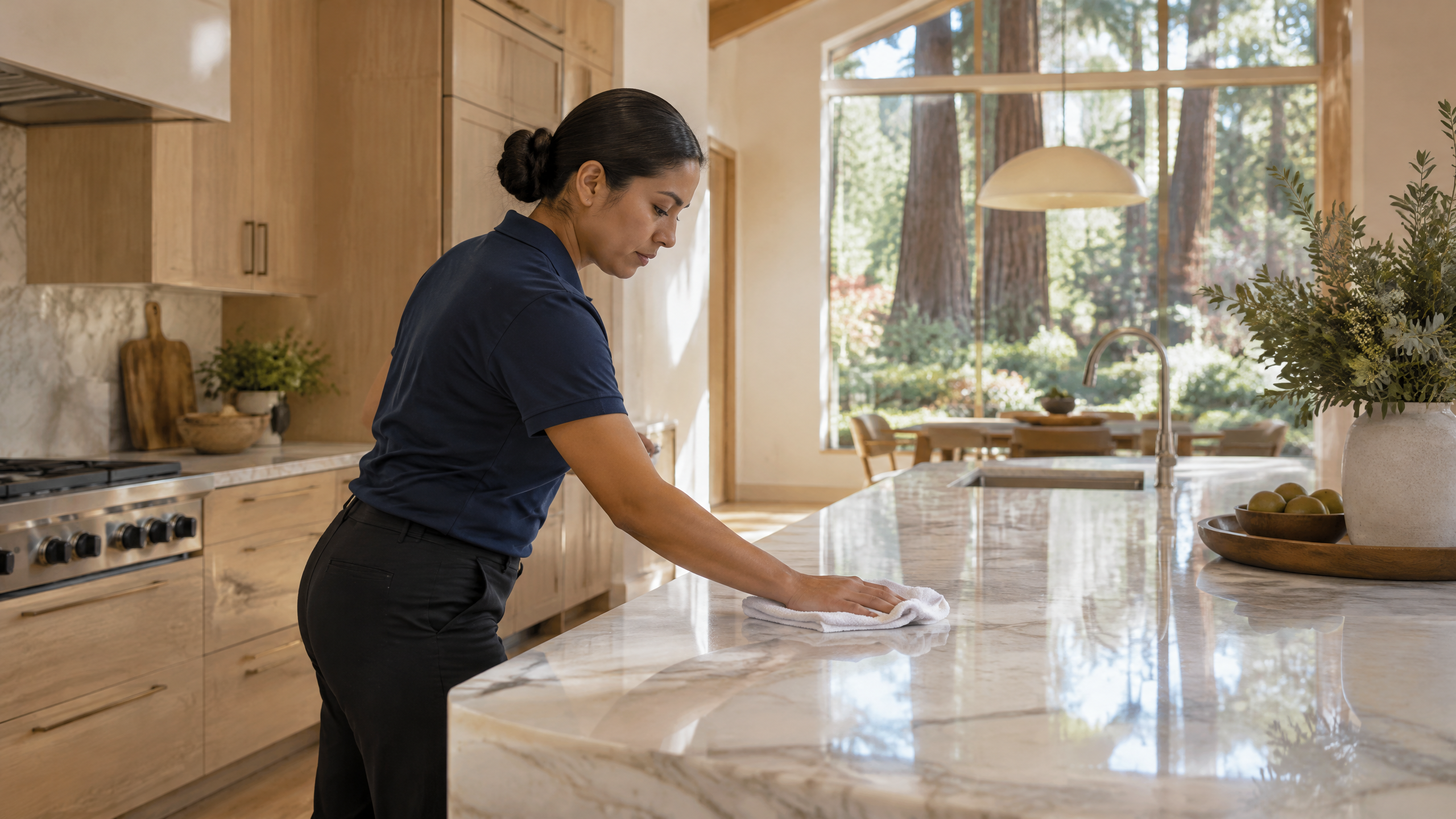



A large home is not simply a smaller home with more rooms. It is a sequence of decisions: where outside debris first enters, which rooms carry daily life, which spaces are used only when people gather, and which materials need a lighter touch. In Mill Valley, those decisions can be shaped by sloped sites, tree cover, decks and paths, and interiors that step across more than one level. A useful cleaning plan follows the way the house actually works rather than treating every room as identical.
The goal is not to make a home feel sterile or overworked. It is to keep high-use areas orderly, reduce the drag of accumulated dust and dampness, and care for finishes in a way that respects their age and construction. That calls for a clear route through the home, honest priorities, and a conversation about access before the visit begins. For homeowners looking for a local starting point, large-home cleaning in Mill Valley can be planned around the home’s layout rather than a one-size-fits-all checklist.
This guide is for homes with several bedrooms, multiple baths, distinct living zones, stairs, guest spaces, or a substantial indoor-outdoor threshold. Use it to set a realistic scope, decide what needs attention first, and ask better questions before booking. It is equally useful before a one-time reset and when designing a recurring rhythm.
Practical note: Choose the method for the actual surface, follow product and manufacturer instructions, and test a discreet area whenever a finish is uncertain.
Begin with the home’s circulation, not its room count
Square footage matters, but circulation tells the more useful story. A large Mill Valley home may have a front entry, a side door used after a walk, a garage transition, a mudroom, a lower-level family room, and bedrooms that sit on a separate floor. Each route introduces a different kind of work. Some carry shoes and leaves; some carry school bags, pet supplies, or groceries; some are quiet most of the week and suddenly become active when guests arrive. A cleaning plan that begins only with bedroom and bathroom totals can miss these daily pressure points.
Walk the property as a resident would. Note the doors used most often, the path from parking to kitchen, the stairs that connect the main living areas, and the surfaces people touch as they pass through. Then distinguish between spaces that should look finished every visit and spaces that can rotate through a deeper attention cycle. This simple map helps prevent a familiar large-home problem: a great-looking formal room alongside an entry, landing, or powder room that absorbs all the visible wear.
Layered layouts need an order that minimizes backtracking. In many homes, it makes sense to start on the least-used upper or lower level, work toward the main living zone, and finish near the exit. The exact route should change if a resident is working at home, a child is napping, or a particular room must remain available. What matters is stating those constraints early. A route is not a rigid ritual; it is a way to protect time for the rooms that will matter after the door closes.
Scope is also about boundaries. Decide whether the visit concerns lived-in rooms only, selected guest rooms, inside cabinets, interior glass, a pantry reset, a laundry zone, or detailed work behind movable items. Naming those choices avoids the assumption that a large footprint automatically includes every occasional task. It also makes the final walk-through more useful because everyone is checking the same priorities.
- Mark every routine entry point and the surface directly inside it.
- Separate daily-use rooms from guest, office, hobby, and storage zones.
- Identify stairs, landings, and hallways that need to stay clear during the visit.
- List spaces that require a rotating detail plan rather than attention at every appointment.
Treat entryways as the home’s working threshold
In a wooded or hillside setting, the entry earns more attention than its square footage suggests. Fine grit, needles, dry leaves, water from shoes, and debris carried in from a deck or path can collect in a surprisingly small area. The practical response is not aggressive scrubbing. It is a repeatable sequence: remove loose debris, attend to the floor according to its finish, wipe the touchpoints that are actually used, and reset the zone so the next arrival does not spread the day’s outdoors through the house.
A well-planned threshold has a clear handoff. A mat or runner catches what it can, a bench or landing spot keeps bags off the floor, and a nearby basket or tray contains shoes and wet-weather items. These are household systems, not decorations. Before a cleaning visit, emptying that zone gives the work room to reach the floor edges, baseboards, door trim, and the area behind the door swing. If the entry doubles as a drop zone, agree whether organizing is part of the visit or whether the household will reset it beforehand.
Pay special attention to transitions between exterior-facing doors and finished floors. Water should not be left sitting on wood, seams, or unsealed grout. If a surface looks persistently darkened, swollen, lifted, or otherwise changed, cleaning should pause long enough for the homeowner to consider the condition and the appropriate next step. Cleaning can remove ordinary surface soil; it should not disguise a material issue or turn a small concern into a larger one.
The entry also sets the tone for a team’s arrival. Clear directions on the preferred door, where to park, whether a gate or stair route is involved, and where supplies may be staged reduce uncertainty. In a large home, the first five minutes can determine whether the rest of the visit moves smoothly or begins with avoidable searching.
- Clear shoes, bags, deliveries, and umbrellas from the primary entry before arrival.
- Specify the door, parking location, gate instructions, and any stairs on the approach.
- Point out finishes that should not receive excess water or abrasive treatment.
- Keep a simple containment spot for items that need the homeowner’s decision.
Sequence the rooms by use, privacy, and reset value
A large-home visit is most effective when rooms are grouped by how they function. Start with private areas that are not likely to be interrupted, then move through baths and bedrooms, and reserve the kitchen, family room, and main entry for a final reset when possible. This is not the only sequence, but it avoids repeatedly crossing finished floors and lets the most visible shared spaces look settled at the end of the work.
Bathrooms deserve their own route because they combine touchpoints, moisture, fixtures, and multiple finishes in a compact space. A main-floor powder room may need attention every visit even when a seldom-used guest bath rotates. In bedrooms, the priorities can differ: a primary suite may need regular attention to visible surfaces and floors, while a guest room may benefit more from a light check, ventilation, and a scheduled detail before visitors arrive. Let actual use determine the cadence.
For kitchens and adjacent dining areas, decide what a standard reset means in your home. It might include clear accessible counters, sink and fixture attention, exterior appliance surfaces, dining chairs, and floor care. It need not mean sorting stacks of mail, choosing what to keep, or moving fragile collections without instruction. The more clearly a household separates cleaning from decisions about belongings, the more focused the visit can be.
Shared rooms often have layered surfaces: shelves, low tables, upholstery-adjacent edges, built-ins, window ledges, media furniture, and floor transitions. A practical plan names the surfaces that should be dusted routinely, the objects that should remain untouched, and the elements that need a periodic detail. This preserves the calm of the room without treating every decorative object as a task to be rearranged.
- Protect work-from-home rooms or nap spaces by assigning a quiet time window.
- Put the most visible kitchen, powder room, and living areas near the end of the route.
- Rotate low-use guest rooms and secondary baths through a documented schedule.
- Label or point out items that should never be moved, dusted, or handled.
A practical large-home visit planner
Use this planning view to match each type of area to a sensible level of attention. It is a conversation tool, not a substitute for a property-specific scope.
| Area or decision | Routine priority | What to prepare or communicate | When to add detail |
|---|---|---|---|
| Primary entry and landing | Loose debris, touchpoints, floor reset, and visible edges | Preferred entry, shoe and bag clearance, sensitive floor finish | After wet weather, heavy outdoor use, or a gathering |
| Kitchen and dining zone | Accessible counters, sink, exterior appliance surfaces, chairs, and floor | Clear personal items; identify special stone, wood, or metal care | After hosting, extended cooking, or a change in routine |
| Active bathrooms | Fixtures, touchpoints, visible surfaces, floor, and dry finish where appropriate | Ventilation notes, finish sensitivities, and rooms that are closed | When guest use increases or moisture-related conditions need attention |
| Bedrooms and offices | Primary suite and active room surfaces; secondary rooms on rotation | Work calls, naps, off-limits spaces, fragile objects | Before guests arrive or after a period of low use |
| Stairs, halls, and lower levels | Clear paths, rail touchpoints, visible floor edges | Stair access, storage doors, and items that cannot be moved | When transitions show buildup or the household changes its daily route |
| Finish-sensitive rooms | Care only as specified for the material | Manufacturer guidance, care cards, and a point of contact for questions | After repairs, refinishing, or when the condition is uncertain |
| Access and pricing | A workable arrival, staging, and communication plan | Parking, gates, stairs, pets, contacts, and full home details | Use /estimate for an exact quote based on size, condition, baths, access, and scope |
Use moisture awareness as a maintenance habit
Mill Valley’s relationship to the landscape is part of its appeal, and homes can experience different conditions from one elevation, exposure, or tree canopy to another. Shaded exterior doors, bathrooms without much air movement, lower levels, and rooms that open to decks may stay damp longer after rain or a cool morning. The cleaning implication is straightforward: use only the moisture the surface needs, dry areas that should not stay wet, and notice changes rather than trying to clean through them.
This is especially important around window sills, door thresholds, bath surrounds, under-sink areas, and the edges of flooring. A recurring visit is a useful moment to check whether ordinary dust, splash marks, or debris are collecting, but it is not a substitute for diagnosing leaks, failed seals, or building-envelope concerns. If there is a persistent odor, recurring visible growth, water staining, softened material, or an unexplained wet area, the appropriate response is to notify the homeowner and seek qualified building or repair guidance as needed.
Ventilation is part of the reset. After bathing or cooking, use the home’s normal ventilation practices and give damp textiles or mats an opportunity to dry. In an unused guest suite, occasional air circulation and a quick visual check can be more valuable than a last-minute intensive clean before company arrives. Small, routine observations preserve options; waiting until a surface is visibly compromised narrows them.
Ask in advance about rooms that are often closed, windows that should remain shut, and exterior doors that may be affected by weather. A plan can respect security, indoor comfort, and the home’s own routines without making assumptions about conditions on a given day.
- Keep bath and entry mats dryable and easy to lift for floor access.
- Mention any known seepage, sensitive window areas, or rooms that stay closed.
- Use a dry finish on surfaces that should not retain standing moisture.
- Escalate persistent water-related changes to the appropriate home professional.
Match the cleaning method to the finish
Large homes often combine materials with very different care needs: sealed or unsealed stone, wood floors, painted millwork, metal fixtures, glazed tile, glass, lacquered furniture, and specialty wall finishes. The most protective instruction is also the simplest: identify the material before selecting the method. A product that is ordinary on one surface may leave a film, dull a finish, or create an avoidable question on another.
Before the first detailed visit, make a short finish list. Include natural stone, engineered surfaces, wood species or floor manufacturer guidance if known, delicate metals, hand-painted or waxed pieces, and any recently refinished area. Keep manufacturer care information where it can be shared. When the finish is unknown, a cautious approach and a small inconspicuous test are more sensible than a confident guess. This is particularly valuable in older homes, additions, and rooms where materials changed across remodels.
Wood deserves restraint. Dust and loose grit are abrasive over time, while excess liquid can be problematic at joints, edges, and worn finish areas. Stone and tile need similar specificity: grout, sealers, and stone composition affect how a surface responds. Metal fixtures may show mineral marks or fingerprints, but a bright shine should never be pursued at the cost of the surface itself. Cleaning is finish care, not surface transformation.
Make special handling visible. A note near a delicate vanity, an instruction in the booking notes, or a labeled care card can prevent a well-intended error. Include art, heirlooms, specialty hardware, and objects with loose parts. A good plan says what should be done, what should be avoided, and who makes the call if a new condition is noticed.
- Provide care notes for stone, wood, specialty metals, and recently refinished surfaces.
- Flag areas where a prior product has left residue, haze, or streaking.
- Keep fragile objects and small loose parts secured or clearly excluded from handling.
- Ask that uncertainty about a finish be raised before a new method is used.
Plan access, staging, and household privacy before the visit
A large home has logistical needs that do not show up in a room list. A steep driveway, a narrow side path, multiple exterior doors, a detached studio, a gate, limited street parking, or several flights of stairs can change how a visit begins and how supplies move through the property. Share these details while booking, not when the team arrives. Access information gives everyone a chance to set a safe, workable route.
Decide who will be present and what should happen if no one is home. Written instructions should cover the preferred entry, alarm or lockbox process if applicable, rooms that are off limits, pets, parking, restroom access if relevant, and the best contact method for a question. Keep codes and sensitive information limited to the necessary channel, and update them when household arrangements change. Clear instructions are kinder to both the household and the people doing the work.
Staging is a small detail with outsized value. Designate a place for supplies that does not block a family path or a main room. In a multi-level home, clarify whether supplies can be moved between floors and whether any stairs, landings, or storage doors require special care. If a homeowner has preferred tools or finish-specific products, note that in advance and make the labels available. Do not assume an unfamiliar product is suitable without checking its intended surface.
Privacy is equally practical. Put away paperwork, medication, jewelry, cash, and personal devices before any service visit. Close drawers and cabinets you do not want opened. If a resident will be on a call, working, recovering from travel, or caring for a child, communicate the quietest route and the periods when a room cannot be entered. A thoughtful access plan lets a cleaning team work independently while the home remains comfortably lived in.
- Share parking, gate, stair, and preferred-entry details in advance.
- Name off-limits rooms, contact preferences, pets, and timing constraints.
- Choose a supply staging area that does not obstruct the household’s route.
- Secure private, valuable, or decision-sensitive items before the appointment.
Choose frequency by workload, not by aspiration
The right cadence is the one that matches how quickly a home’s priority zones become difficult to reset. A household that cooks frequently, hosts often, uses several entries, or has active children and pets may value weekly attention to the kitchen, baths, floors, and thresholds. A quieter household may prefer a biweekly rhythm with a defined rotation for guest rooms and less-used levels. Neither choice is a measure of how well a home is kept; it is a planning decision about workload.
Recurring care works best when the core scope is stable. Keep the main living zones, active baths, kitchen, entries, and primary bedroom routine, then choose one or two detail zones to rotate. Examples include interior ledges in a guest room, a secondary stair, a library shelf, a laundry room, or the baseboards in one level. This keeps each appointment focused while ensuring that the whole home is not reduced to a perpetual list of deferred work.
A deeper appointment can be useful when the home has gone through a busy season, a project, extended travel, a move, or a change in household routine. It should be described in terms of tasks and condition rather than treated as an automatic add-on. Inside storage, detailed edges, accumulated kitchen soils, and seldom-touched surfaces require more time than a normal reset. State the desired outcome and ask which tasks are realistic within the chosen scope.
Cost should be clear before the visit. Standard cleaning starts at $240 and is priced with flat fees. Weekly Clean+ is 25% off, and biweekly Clean+ is 20% off. For reference, deep cleaning of a 2BR/2BA home is about $480 and a 3BR/2BA home about $600; a 4BR/3BA deep cleaning is about $780 and a 5BR/4BA home about $960. These are planning estimates, not a substitute for an exact quote: home size, condition, bathrooms, access, and scope all affect the price. Use /estimate for the exact quote.
- Set a stable core scope for every recurring visit.
- Assign detail zones to a rotation instead of asking for all deep tasks at once.
- Reassess cadence after hosting, seasonal changes, travel, or household transitions.
- Confirm flat-fee scope and use /estimate when an exact quote is needed.
Prepare the home so cleaning time stays focused
Preparation does not mean making the home spotless before help arrives. It means clearing the decisions that only the household can make. Put away clothing, paperwork, toys, dishes that need special handling, open packages, and loose cords. Remove items from counters or floors only where you want full surface access. This turns a visit from a sorting exercise into a cleaning appointment and gives priority rooms the attention they deserve.
Use a short pre-visit note rather than a long verbal handoff. List the two or three outcomes that matter most that day, such as resetting the kitchen after guests, concentrating on the primary suite, or bringing the entry and lower-level bath back to order. Add changes from the regular plan: a room to skip, a new fragile object, a closed door, a visitor expected later, or a finish that has recently been repaired. Concise notes are easier to act on than a general request to clean everything.
If you want organizational help, describe it as a separate objective. Cleaning can reveal surfaces and improve the feel of a room, but deciding where possessions belong takes household judgment. A tray of unidentified items, a closet packed with mixed belongings, or a crowded desk can quickly absorb attention intended for bathrooms or floors. Choose in advance whether those areas are excluded, lightly reset, or addressed in a separate session.
After the visit, use a quick review to improve the next one. Did the route match the day’s needs? Was a low-use room given too much attention while a daily zone needed more? Were care instructions clear? A large home benefits from iteration. The best plan becomes more precise over time because it learns from the actual rhythm of the household.
- Clear decisions, clutter, and valuables from surfaces you want fully cleaned.
- Write down the day’s top priorities and any changes to access or room use.
- Separate cleaning requests from sorting and organizing decisions.
- Use a brief post-visit review to adjust the recurring plan.
Ask precise questions before you book
A well-matched service begins with questions that reveal the home’s complexity. Describe the number of active bedrooms and baths, the levels that need attention, the primary entry, special finishes, and any access constraints. Then ask how the scope will distinguish routine work from a more detailed clean. The answer should make it easier to picture what happens in your kitchen, baths, entries, and less-used rooms—not simply provide a broad label.
Ask how to communicate finish notes and priorities, what preparation will make the visit most effective, and how to update instructions from one appointment to the next. If there are multiple household members, choose one person to consolidate notes. This avoids contradictory requests and gives the cleaning plan a clear point of contact. For a first look at local options, the Mill Valley home-cleaning page is a useful place to frame the conversation around your own home.
Discuss timing in practical terms. Is there a window when a home office is quiet? Does a guest room need to be ready by a certain afternoon? Are there stairs or exterior approaches that take longer to navigate? The point is not to demand a minute-by-minute schedule. It is to give the work a sensible order and to avoid treating access time as invisible.
Finally, ask for clarity on price and scope before committing. Explain whether you are considering a standard visit, a deeper reset, or recurring care, then provide accurate home details. A precise conversation is more valuable than a vague promise because it lets the household choose priorities with open eyes. Homeowners comparing layouts and needs can also use cleaning options for larger Mill Valley homes to prepare the right questions.
- What areas are included routinely, and what requires a separate detailed scope?
- How should finish instructions, off-limits rooms, and priority notes be shared?
- What access details or preparation will affect the plan for this property?
- How will the flat fee reflect size, condition, bathrooms, access, and selected tasks?
Build the visit around the way your home is used
A large Mill Valley home becomes easier to care for when the plan starts at the threshold, follows the lived-in rooms, and respects the materials along the way. Bring a simple list of active spaces, access details, finishes that need care, and the two or three results that would make the greatest difference after the visit.
If you are comparing a first reset with recurring care, begin with the actual workload rather than an idealized checklist. Standard cleaning starts at $240 with flat fees; weekly Clean+ is 25% off and biweekly Clean+ is 20% off. Deep-cleaning estimates vary with home size, condition, bathrooms, access, and scope. For the exact price for your property, go to /estimate and provide the details that shape the work.
Frequently asked questions
What makes a Mill Valley home a large-home cleaning project?
It is less about one number than about the work created by the layout. Multiple levels, several bathrooms, guest rooms, separate living zones, long transitions from parking or a path, and finish-sensitive rooms all add planning needs. Describe the active rooms, levels, entries, and priorities instead of relying on a label. That gives the service a clearer picture of the home and helps you decide what should be routine versus rotated.
How should I decide between a standard visit and a deeper clean?
Choose a standard visit when the home mainly needs a consistent reset of active kitchens, baths, living zones, entries, and floors. Consider a deeper clean when buildup, neglected edges, inside storage, seldom-used rooms, or a change in household routine needs more concentrated attention. Explain the condition and desired outcome before booking. A deeper scope should be based on tasks, materials, and access, not just a broad name.
Do I need to be home, and what access information should I provide?
You can decide the arrangement that is comfortable for your household, but access should be explicit. Provide the preferred entry, parking or gate details, any stairs or detached spaces, contact method, rooms that are off limits, pet information, and instructions for a lock or alarm process if applicable. Put away sensitive personal items and tell the team about work calls, naps, or other times when rooms should remain quiet.
What should I expect to pay for a large-home cleaning visit?
Standard cleaning starts at $240 and uses flat fees. Weekly Clean+ is 25% off, while biweekly Clean+ is 20% off. As deep-cleaning planning references, a 2BR/2BA is about $480, a 3BR/2BA about $600, a 4BR/3BA about $780, and a 5BR/4BA about $960. Estimates depend on home size, condition, bathrooms, access, and scope. Visit /estimate for an exact quote for your home.
What are the most useful questions to ask before booking?
Ask what the routine scope covers in your active rooms, how detailed tasks are handled, how to share finish-care instructions, what preparation is expected, and how access affects the plan. Confirm how a flat fee is determined and provide accurate details about levels, bathrooms, entrances, and rooms to rotate. The strongest booking conversation is specific: it names the outcomes you want and the conditions that could change the work.
Need help with the next step? large-home cleaning in Mill Valley or request a flat-fee estimate for your home.
Let Green Planet Handle the Cleaning
Family-owned since 2010. 100% eco-friendly. Greentified™ Guarantee — if you're not happy, we re-clean for free within 24 hours.
Serving Marin County, San Francisco, Sonoma, Napa, San Mateo & Contra Costa.