

You just finished a renovation. The contractor has packed up, the new floors are down, the kitchen cabinets are installed, and the space looks incredible — except for the layer of fine white dust coating every single surface. That dust is construction debris: drywall particles, silica, joint compound, sawdust, and fiberglass insulation fragments. And it doesn't just sit on countertops. It's suspended in the air, settled inside HVAC vents, and embedded in every corner of the room.
A regular vacuum won't fix this. A shop vac won't fix this. What you need is HEPA filtration — and a cleaning team that knows how to use it correctly. At Green Planet Cleaning Services, every post-construction clean we perform in San Francisco uses HEPA-filtered equipment as the foundation of our process. Here's everything you need to know about why it matters and how we do it.
What Is a HEPA Filter — and What Does It Actually Do?
HEPA stands for High Efficiency Particulate Air. To earn the HEPA designation, a filter must capture at least 99.97% of particles that are 0.3 microns or larger in diameter. For reference, a human hair is roughly 70 microns wide. The particles that HEPA filters are designed to catch — drywall dust, silica, mold spores, pollen, pet dander, and fine construction debris — are invisible to the naked eye and small enough to bypass the respiratory system's natural defenses and lodge deep in lung tissue.
A standard vacuum, even a high-quality one without a HEPA filter, captures large debris but exhausts fine particles back into the air through its motor and bag seams. You can actually make air quality worse by vacuuming a post-construction space with a non-HEPA machine — you're picking up the visible dust while recirculating the dangerous microscopic particles that you can't see.
The 0.3 Micron Standard — Why That Size?
HEPA filters are tested at 0.3 microns because that's the most penetrating particle size (MPPS) — the size at which particles are hardest to capture. Larger particles are caught by impaction and interception. Smaller particles are caught by diffusion. Particles right at 0.3 microns slip through both mechanisms most easily. A filter that captures 99.97% at 0.3 microns will capture an even higher percentage of both larger and smaller particles. This is why HEPA is the gold standard for medical, laboratory, and cleanroom environments — and why it's the right tool for post-construction dust.
Why Post-Construction Dust Is a Serious Health Concern
Most homeowners assume construction dust is just an aesthetic problem — something to wipe up and move on from. The reality is more serious. Post-construction environments contain several categories of hazardous fine particles:
- Crystalline silica: Found in drywall, concrete, tile, and grout. Repeated inhalation causes silicosis, a progressive and irreversible lung disease. The EPA classifies fine silica as a Group 1 carcinogen.
- Drywall dust (calcium sulfate): Irritates the respiratory tract, eyes, and skin. Fine particles can trigger asthma attacks and worsen existing respiratory conditions.
- Fiberglass insulation fibers: Microscopic glass fibers that can penetrate lung tissue and cause long-term irritation.
- VOCs from paints, adhesives, and sealants: Volatile organic compounds off-gas for days or weeks after application and can cause headaches, dizziness, and respiratory irritation.
- Lead dust (older SF homes): San Francisco has a significant stock of pre-1978 housing. Any renovation disturbing painted surfaces in these homes can release lead dust — a serious neurotoxin with no safe exposure level for children.
- Mold spores: Renovation work that disturbs walls or subfloors can release dormant mold spores into the air, which can then settle and colonize in new locations if moisture is present.
This is not a list of theoretical risks. These are documented occupational and residential health hazards. The solution isn't to open a window and let things air out — it's to physically remove the particles from the environment using the right equipment.
How HEPA Vacuuming Works in a Post-Construction Clean
HEPA vacuuming is not the same as regular vacuuming. The technique, the sequence, and the equipment all matter. Here's how our team approaches it on every post-construction job in San Francisco:
1. Top-Down, Room-by-Room Sequencing
Construction dust obeys gravity. It settles on every horizontal surface — shelves, window sills, cabinet tops, baseboards, and floors. If you vacuum the floor first and then wipe down the shelves, you're recontaminating the floor. Our team always works top-down: ceiling fans and light fixtures first, then walls and upper shelves, then countertops and furniture surfaces, then baseboards, and finally the floor. This ensures that disturbed dust falls onto surfaces that haven't been cleaned yet.
2. HEPA Vacuum on All Surfaces — Not Just Floors
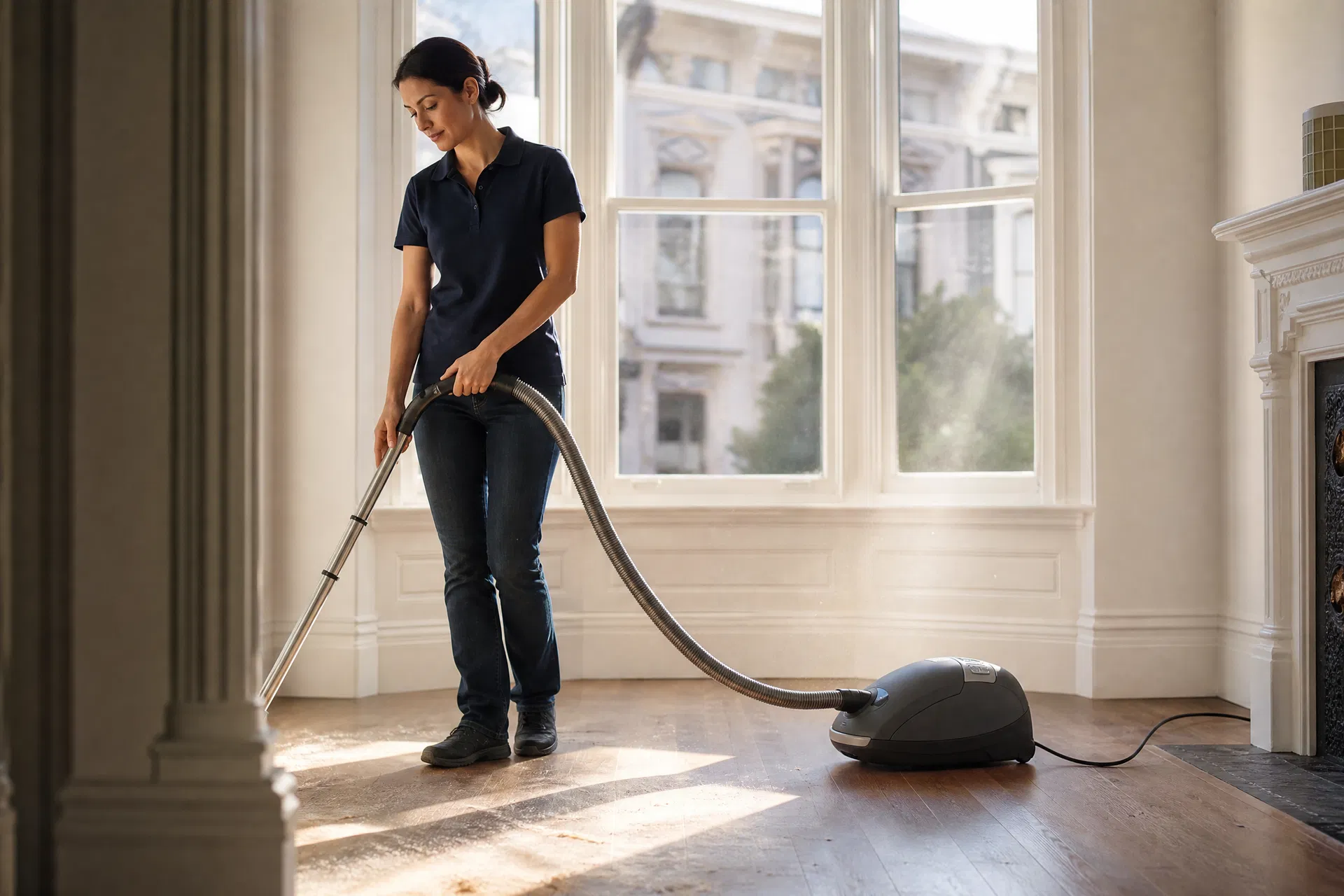
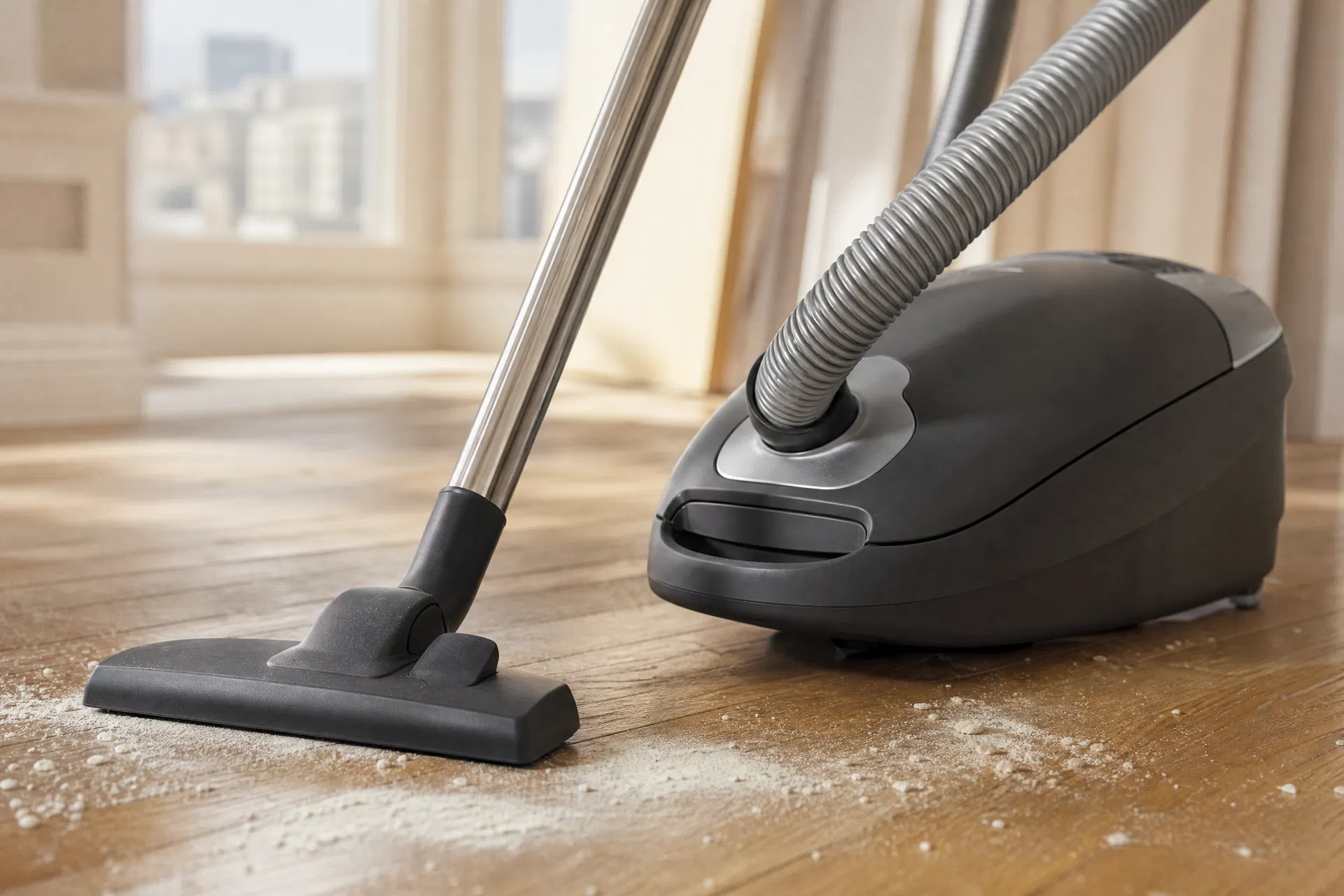
We use HEPA-filtered canister vacuums with multiple attachments to vacuum every surface before any wet wiping begins. This includes window sills, cabinet interiors, drawer tracks, inside closets, along baseboards, and inside HVAC vents. The goal is to remove as much dry particulate as possible before introducing any moisture, which can turn dust into a paste that's harder to remove and can promote mold growth.
3. HEPA Vacuum Before and After Wet Wiping
After the initial HEPA vacuum pass, we do a wet wipe of all surfaces with microfiber cloths and appropriate cleaners. Then we HEPA vacuum again. This two-pass approach catches particles that were loosened by the wet wipe and settled back onto surfaces. It's more time-consuming than a single pass, but it's the only way to achieve a genuinely clean result.
4. HVAC Vents and Returns
One of the most commonly missed areas in a post-construction clean is the HVAC system. Construction dust gets pulled into return air vents and distributed throughout the building every time the system runs. We vacuum all accessible vent covers and returns with HEPA attachments. For major renovations, we also recommend having your HVAC ducts professionally cleaned before running the system — this is outside our scope but we always flag it.
5. Window Tracks and Door Frames
Window tracks are dust traps. Construction debris settles into the channels and grooves and is nearly impossible to remove with a cloth alone. We use narrow HEPA vacuum attachments to pull debris out of tracks before wiping, which prevents the gritty residue that scratches glass and damages window seals over time.
Why Green Planet Uses Miele HEPA Vacuums
Not all HEPA vacuums are equal. The HEPA filter itself is only one component of a sealed filtration system. If the vacuum body, hose connections, or bag seams aren't airtight, fine particles bypass the filter entirely and exhaust back into the room. This is called filter bypass, and it's a problem with many consumer-grade HEPA vacuums.
We use Miele Classic C1 canister vacuums with Miele's AirClean sealed system. Miele engineers their vacuums as a complete sealed unit — the filter, the bag, the hose connections, and the motor housing are all designed to work together with zero bypass. Independent testing by the Allergy Standards Limited (ASL) organization has certified Miele vacuums as genuinely effective for allergen and fine particle removal, not just the filter in isolation.
The Miele C1 is also built for professional use. The motors are rated for thousands of hours of operation, the hoses don't crack under repeated use, and the suction remains consistent throughout the bag's fill cycle. For post-construction work — which is significantly harder on equipment than routine house cleaning — this durability matters.
Beyond HEPA Vacuuming: Our Full Post-Construction Process
HEPA vacuuming is the foundation of a proper post-construction clean, but it's not the only tool we use. Here's the complete process our team follows on every job:
Microfiber Cloths — Not Paper Towels or Cotton Rags
Microfiber cloths have a split-fiber structure that physically traps particles rather than pushing them around. A cotton rag or paper towel smears fine dust across surfaces. Microfiber picks it up and holds it. We use color-coded microfiber cloths (different colors for different areas — bathrooms, kitchens, general surfaces) to prevent cross-contamination, and we wash them between jobs.
pH-Neutral Cleaners for Finished Surfaces
Post-construction surfaces include new paint, fresh grout, unsealed stone, and factory finishes on appliances and cabinetry. Acidic or alkaline cleaners can etch, discolor, or strip these finishes. We use pH-neutral, plant-based cleaners — primarily Method All-Purpose and Seventh Generation — that are effective on construction residue without damaging new surfaces.
Bon Ami for Stubborn Residue
Grout haze, caulk residue, and paint overspray sometimes require a mild abrasive. We use Bon Ami powder cleanser, which is non-scratching and free of bleach, dyes, and synthetic fragrances. It's effective on tile, porcelain, and stainless steel without leaving chemical residue.
Bona Hardwood Floor Cleaner
New hardwood floors are particularly vulnerable after a renovation. Construction debris can scratch the finish, and the wrong cleaner can leave residue that dulls the surface. We use Bona Hardwood Floor Cleaner — a water-based, pH-neutral formula specifically designed for finished hardwood — applied with a flat microfiber mop after HEPA vacuuming.
Window and Glass Cleaning
Post-construction glass has a particular challenge: fine silica and drywall dust can bond to glass surfaces and leave a haze that's difficult to remove with standard glass cleaner. We use a two-step process — first a damp microfiber wipe to lift the bonded particles, then a streak-free glass cleaner finish. For exterior windows, we address construction splatter with appropriate non-abrasive techniques.

Post-Construction Cleaning in San Francisco: What Makes It Different
San Francisco's housing stock presents specific challenges that affect how post-construction cleaning needs to be approached. Understanding these factors is part of why local experience matters.
Pre-1978 homes and lead dust: A significant portion of San Francisco homes were built before 1978, when lead-based paint was banned for residential use. Any renovation that disturbs painted surfaces in these homes — sanding, scraping, or demolition — can release lead dust. While lead remediation itself requires a licensed contractor, our team is trained to identify post-renovation environments where lead dust may be present and to use appropriate precautions, including HEPA filtration, which is the EPA-recommended method for lead dust cleanup.
Victorian and Edwardian construction details: SF's characteristic Victorian and Edwardian homes have elaborate millwork, crown molding, built-in cabinetry, and decorative details that collect dust in ways that modern open-plan homes don't. Every carved surface, every corbel, every window seat requires individual attention. Our team uses narrow HEPA attachments and detail brushes to clean these features without damaging them.
Vertical living and shared walls: Many SF homes are multi-story or share walls with adjacent units. Construction dust travels through gaps in flooring, around pipes, and through shared wall cavities. We pay particular attention to baseboards, floor-to-wall transitions, and any areas where construction work may have disturbed existing seals.
Fog and humidity: San Francisco's marine layer means that construction dust left in place can absorb moisture and become harder to remove over time. Getting a thorough post-construction clean done promptly — before the dust has had time to bond to surfaces — produces significantly better results.
What to Expect from a Green Planet Post-Construction Clean
Every post-construction clean we perform follows a structured three-phase process:
Phase 1 — Rough clean: Removal of large debris, construction materials, and packaging. Sweeping and initial HEPA vacuum pass of all surfaces. This phase addresses the bulk of visible debris.
Phase 2 — Detail clean: Full HEPA vacuum of all surfaces top-down, including vents, window tracks, cabinet interiors, and baseboards. Wet wipe of all surfaces with appropriate cleaners. Second HEPA vacuum pass. Window and glass cleaning. Floor cleaning with appropriate product for floor type.
Phase 3 — Final inspection: Our team lead does a room-by-room walkthrough checking for missed areas, streaks on glass, and any surfaces that need a second pass. We don't leave until the space meets our standard.
For most San Francisco residential renovations, a full post-construction clean takes between 4 and 8 hours depending on the size of the space and the extent of the work. We provide a free estimate based on your square footage and project scope before we schedule anything.
Frequently Asked Questions
Ready to Schedule Your Post-Construction Clean?
Get a free estimate for your San Francisco renovation cleanup. HEPA-filtered equipment, W-2 employees, eco-friendly products, and $2M liability coverage on every job.