

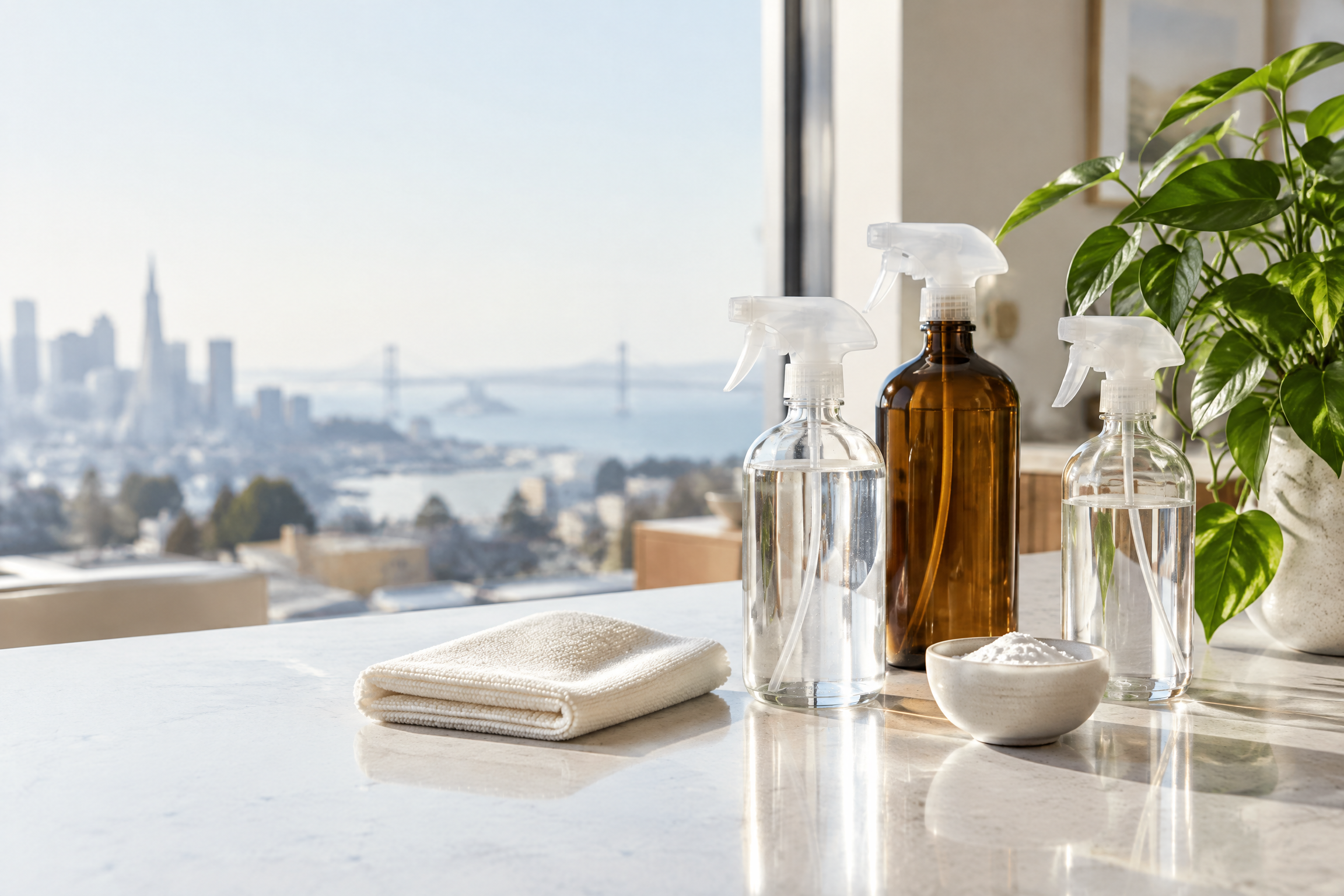
The best non-toxic all-purpose cleaner for everyday messes is not one universal bottle. It is a formula whose label matches the surface in front of you, whose directions fit the task, and whose residue instructions you will actually follow. For a quick wipe of a sealed counter, a small drip on a cabinet front, or fingerprints on a hard, nonporous surface, a thoughtfully chosen multi-surface cleaner can simplify the routine. But ‘all-purpose’ is not permission to use it on every material in the house.
This guide uses the phrase many people search for, not as a claim about every formula on a shelf. Product names, ingredients, allowed surfaces, dilution directions, and cautions can change. Treat the current bottle label and the care information from the surface manufacturer as the deciding documents. The goal is a smaller, better-matched cleaning kit: one everyday spray for its approved uses, plus a few specialty products when a surface or mess calls for them.
Practical note: Choose the method for the actual surface, read the product and manufacturer instructions, and test a discreet area whenever a finish is uncertain.
Start with the surface, not the marketing language
An all-purpose cleaner earns a place in a daily kit when it handles the routine soil you actually see: crumbs, light grease, fingerprints, tracked-in dust, toothpaste splatters, and the film that collects on frequently touched hard surfaces. The useful question is not simply whether a bottle is marketed as non-toxic or multi-surface. Ask instead: Is this particular surface nonporous or sealed? Does the label name it? Does the surface maker ask for a dedicated cleaner? And will the cleaning step leave a residue that must be rinsed or wiped away?
This surface-first approach keeps a simple job simple. A sealed laminate counter, a glazed ceramic tile backsplash, and a glass table may be candidates when the product label includes them. Unfinished wood, a natural-stone countertop of unknown type, a waxed floor, an appliance screen, or a painted wall deserve a pause before spraying. Materials that look similar can have very different finishes, sealers, and care instructions.
For a new product, start small. Read the front and back labels before opening it, identify the material rather than guessing by color, and test on an inconspicuous spot if the product or surface maker recommends it. A small check is especially worthwhile around decorative finishes, older cabinetry, colored grout, custom paint, and unfamiliar stone.
- Choose by approved surface first, then by bottle format, scent preference, refill system, or other personal priorities.
- Keep the original label with any refill bottle so directions and cautions stay available.
- Use a clean, soft microfiber cloth for most wipe-downs; a dirty or abrasive tool can be the cause of marks even when the cleaner is appropriate.
- Do not assume a product that works on one sealed surface is also meant for every floor, screen, fabric, or unfinished material.
How to read an all-purpose cleaner label before buying
The label is the shortest route to a good decision. Look for the specific surface list, directions for spraying or diluting, the instructions for wiping or rinsing, and any limitations. ‘Multi-surface’ is a category, not a complete surface list. A product may be intended for a range of hard, nonporous household surfaces while excluding a material that happens to be in your kitchen or bathroom.
Pay close attention to the finish qualifier. ‘Sealed wood’ and wood are not interchangeable. ‘Sealed stone’ and stone are not interchangeable. A label that includes a countertop does not necessarily include a floor made from the same-looking material. When a product is a concentrate or tablet refill, use the stated bottle size and water amount. Extra concentrate is not automatically extra cleaning power; it can leave film and move the mixture away from the directions on which the label is based.
Ingredient information can be useful for people who want to compare formulas, but it does not replace use directions. Likewise, a third-party program or a manufacturer statement may be one selection factor, not a broad promise about every task or surface. Compare the exact product variation, not merely the brand name, because products within one line can have different instructions.
- Surface list: Match the bottle’s named materials to the object you plan to clean.
- Directions: Note contact time only if the label gives one, plus whether it says to rinse, wipe, or dry.
- Limitations: Look for exclusions involving unsealed, unfinished, waxed, oiled, porous, or delicate surfaces.
- Storage and handling: Keep the bottle closed and use it only as directed; never transfer a cleaner to a food or drink container.
- Change log: When repurchasing, glance at the label again rather than assuming it is identical to a previous bottle.
Everyday all-purpose cleaner options worth comparing
There is no responsible ranking that can name one bottle best for every home without knowing the surfaces, finish conditions, and routine. Instead, compare a few recognizable options against the label and your own material list. The examples below are starting points for a shopping comparison, not a claim that Green Planet Cleaning Services has tested or endorses each product. Buy the current version and follow the current directions on that version.
Method All-Purpose Cleaner is a ready-to-use spray format. Its manufacturer describes use on a range of nonporous household surfaces, including counters, tiles, stone, sealed wood, and glass. That makes it a candidate to compare if those are the materials named on your own bottle and in your home. It does not remove the need to check a particular stone’s or wood finish maker, to test an inconspicuous area when advised, or to use a dedicated floor cleaner where required.
Seventh Generation All Purpose Cleaner is another recognizable spray option to compare. Its product instructions list a range of materials and tell users to spray, rinse, and wipe clean, while also naming exclusions and a caution for certain stone. That is an important reminder that a broad-surface product can still have material-specific limits. Blueland Multi-Surface Cleaner is a refill-tablet system to evaluate if you prefer to make solution in the designated bottle. The manufacturer positions it for counters and sealed wood or sealed stone, and says it is not indicated for floors except spot cleaning on a sealed floor.
- Ready-to-use spray: Often the most direct choice for small, frequent wipe-downs when the label approves the surface.
- Label-specific broad-surface spray: Useful when its allowed-surface list closely matches your kitchen and bath materials and its rinse directions fit your routine.
- Refill-tablet system: A format to compare when you can measure water to the bottle mark, wait for the tablet to dissolve, and retain the current directions.
- Dedicated surface cleaner: The better comparison when a manufacturer calls for one for wood flooring, stone, stainless steel, screens, or another specialty finish.
Everyday surface decision table
Use this pre-cleaning check to choose a category before reaching for a bottle. The product label and the surface manufacturer’s current care instructions take priority whenever they differ.
| Surface or task | Question to answer first | Usually choose | Important caution |
|---|---|---|---|
| Sealed laminate or glazed tile | Does the cleaner label name this hard, nonporous material? | An all-purpose cleaner approved by its label | Finish with the label-directed wipe or rinse step. |
| Glass or mirror | Is the product intended for glass, and is the cloth free of grease? | A glass cleaner or an approved multi-surface product | Use a clean, dry finishing cloth to reduce streaks. |
| Sealed wood cabinet or tabletop | Is the wood finish identified and does the label specifically include sealed wood? | A compatible approved cleaner for a light wipe | Apply to the cloth, avoid seams, and use minimal moisture. |
| Finished wood floor | What does the floor maker recommend for this finish? | A floor-specific cleaner matched to the floor type | Do not assume a counter spray is a whole-floor product. |
| Natural stone | What stone is it, is it sealed, and what does its installer specify? | The stone maker’s recommended mild, non-acidic method | Avoid guessing; acids and abrasives can damage some stone. |
| Engineered quartz | What does the countertop maker list for routine care? | The manufacturer’s recommended routine method | Test a new product inconspicuously and avoid strong or abrasive products. |
| Appliance control panel or screen | Does the appliance manual permit the product and application method? | The appliance maker’s method, often a lightly dampened cloth | Never spray directly into controls, openings, or displays. |
| Heavy grease, mineral buildup, or a mystery mark | What is the deposit and which surface is underneath it? | A specialty product only if both labels allow it | Do not stack or mix cleaners to force a result. |
Use the material map below to choose the right category
The table is a planning tool, not a substitute for a product label or installation paperwork. Start with the material and finish, then select a cleaner category whose instructions match it. If you do not know whether stone or wood is sealed, do not treat that uncertainty as approval. Check with the installer, fabricator, or surface manufacturer before expanding a cleaning routine beyond a damp cloth and the care method they specify.
Natural stone needs particularly careful wording. Stone types vary, and some are sensitive to acidic solutions. The Natural Stone Institute advises mild, non-acidic cleaning for calcium-carbonate stone and warns that products containing lemon, vinegar, or other acids can dull or etch certain stones. Engineered quartz has its own manufacturer guidance; for example, Caesarstone advises testing cleaning products in an inconspicuous area and avoiding strong chemicals, abrasives, and products such as oven or toilet bowl cleaners. A counter’s brand and finish matter as much as its color.
Wood needs a similarly narrow approach. For a finished wood floor, use the floor manufacturer’s recommended method or a product explicitly made for that floor type. Bona notes that excess water and unsuitable cleaning ingredients can damage hardwood flooring, and it differentiates cleaners by floor type. A general household spray may be suitable for an approved sealed-wood spot wipe, but that is not the same as authorizing it as a full-floor cleaner.
A quick method for everyday messes
Technique helps an approved cleaner work as intended. First remove loose debris with a dry cloth or a vacuum attachment appropriate to the surface. Next, apply the product according to its directions, preferably to the cloth when overspray could reach a nearby material, seam, electronic control, or painted edge. Work a modest area, using light pressure. Finish exactly as the label directs: wipe, rinse and wipe, or dry. A clean final cloth is often what prevents haze on glass, darker countertops, or glossy cabinet fronts.
For dried food, splatters, or a greasy ring, resist the urge to turn an everyday spray into a heavy-duty treatment by layering products. Give the allowed product and the label-directed method a chance first. If the mess remains, identify it and move to the surface maker’s recommended specialty approach rather than escalating pressure or experimenting with incompatible cleaners. Do not mix cleaning products together or use one product to neutralize another.
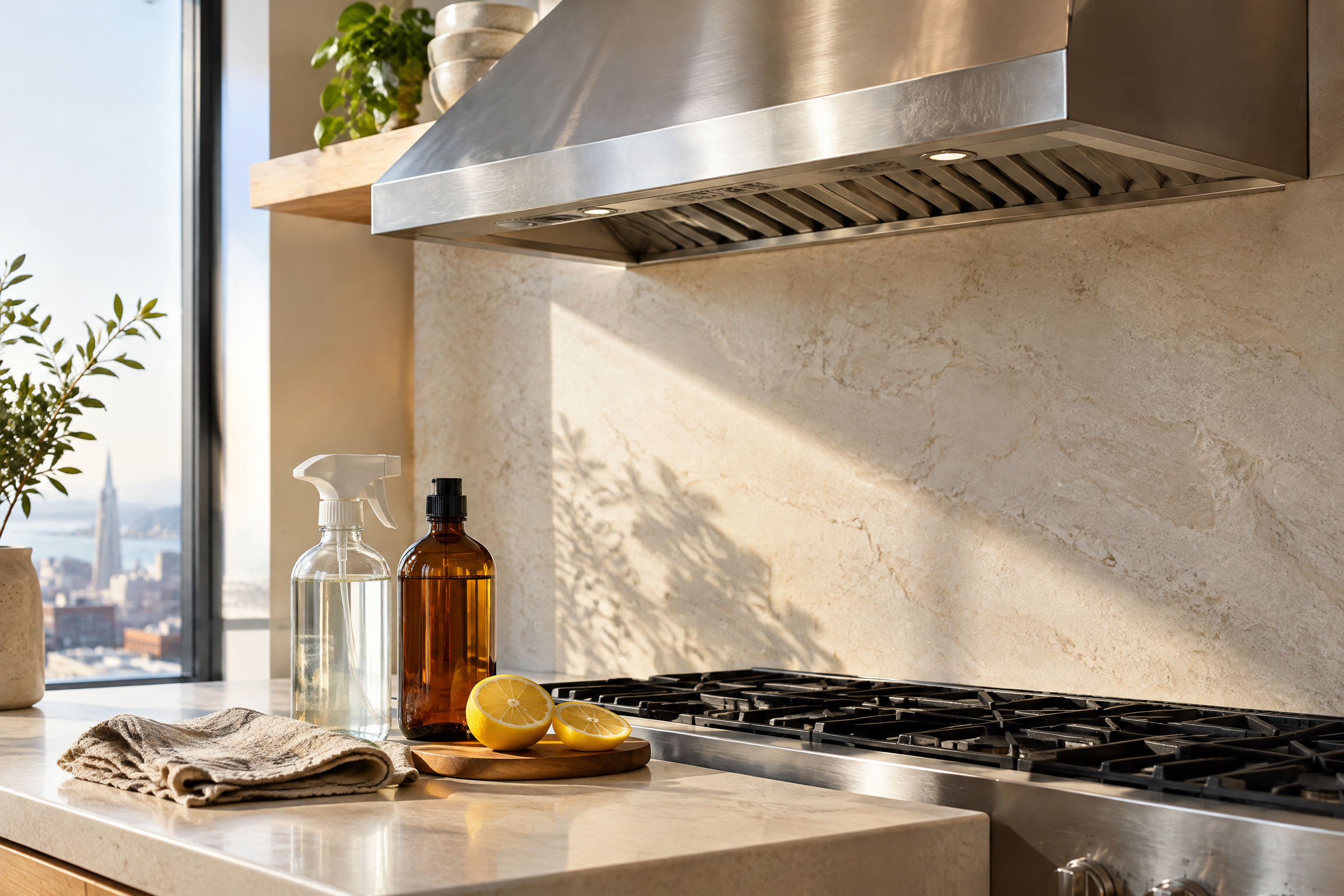
- Kitchen counter after meal prep: Clear crumbs, use only a label-approved product for that counter, then complete any rinse or wipe step the label requires.
- Cabinet fronts and pulls: Spray the cloth rather than hinges, seams, or hardware; use minimal moisture and dry promptly when the finish maker calls for it.
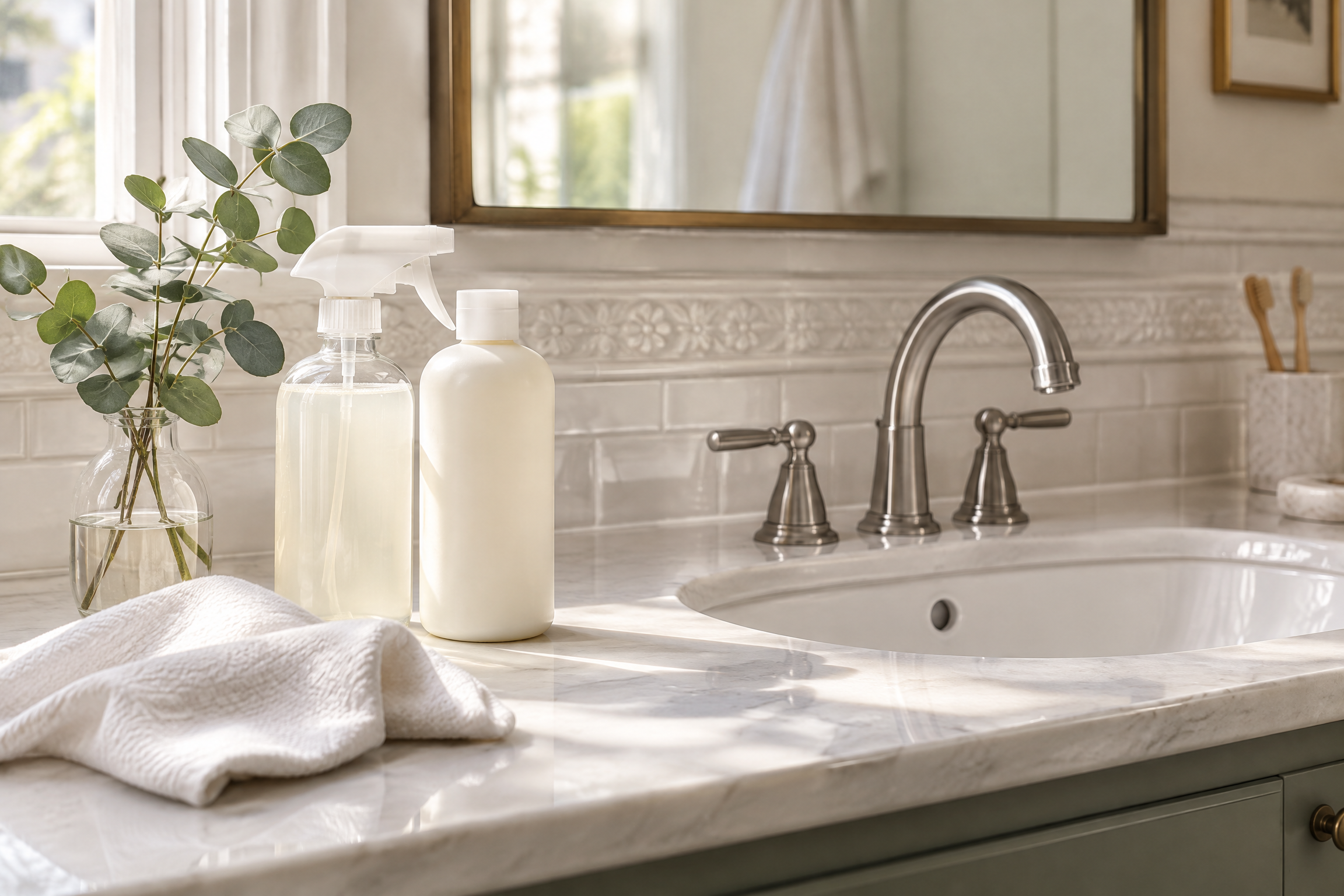
- Bathroom vanity: Confirm whether the top is laminate, solid-surface material, natural stone, or engineered stone before selecting the bottle.
- Tile backsplash: Use a cleaner approved for the tile and grout conditions; do not scrub decorative or damaged grout aggressively.
- Glass table or mirror: Choose a product intended for glass if streaks remain; use a separate cloth from the one used for grease or sink residue.
- Appliance exterior: Check the appliance care guide, keep liquid away from controls and openings, and avoid spraying a display directly.
Know when all-purpose cleaner is not the answer
A multi-surface cleaner is a cleaning product, not automatically a disinfectant, a drain treatment, an oven cleaner, a rust remover, a floor finish, or a stain-removal system. Do not infer any of those uses from the words ‘all-purpose’ or from a brand name. If a task needs a particular outcome, choose a product whose label is specifically intended for that use and follow its directions. For any surface that contacts food, follow the product label and the surface manufacturer’s instructions for cleaning and rinsing.
Skip experimentation on unknown stone, unsealed concrete, unfinished or oiled wood, leather, silk, wool, absorbent upholstery, antique finishes, damaged coatings, and electronics. A soft cloth with the material maker’s approved method may be more appropriate than a general cleaner. For a stubborn mark on an expensive or irreplaceable surface, document the material and contact the manufacturer, installer, or a qualified restoration professional before trying multiple products.
- Use a product specifically intended for oven interiors, toilet bowls, drains, or metal tarnish only where the label and surface guidance allow it.
- Do not use acidic products on natural stone unless the stone-care professional explicitly directs otherwise.
- Do not use abrasive powder, scouring cream, or rough pads simply because a routine spray did not remove a mark.
- Do not mix bleach with ammonia or combine any cleaners; follow the label’s handling directions and keep products in their original containers.
- For floors, use the cleaner and moisture level recommended for that flooring, not the most convenient bottle under the sink.
Build a smaller routine that is easier to repeat
A practical kit often has fewer bottles than a cleaning aisle suggests. Begin with one all-purpose cleaner approved for the nonporous or sealed everyday surfaces you have, a dedicated floor product if your flooring calls for one, a glass-specific option if you need it, soft microfiber cloths, and a small caddy. Add a specialty product only after you can name the material and the job it addresses. This makes it easier to store products correctly, avoid grabbing the wrong bottle, and notice when the label directs a rinse or a different tool.
Set up cleaning cloths by task rather than color alone: one for kitchen counters, one for bathroom fixtures, one for glass, and one for dusty or dry work. Wash and dry them according to their care labels, and retire a cloth that has picked up grit or a stubborn odor. Keep cleaners away from heat and out of the reach of children. If someone else helps clean, leave the product label visible and communicate the surface limits that matter in your home.
- Before shopping: List countertop, cabinet, tile, floor, and appliance materials room by room.
- At purchase: Photograph or save the current product directions and material exclusions for quick reference.
- During cleaning: Work from less soiled areas to more soiled ones and change cloth sides before they become visibly dirty.
- After cleaning: Put away only dry tools and review any unfamiliar spot or change in sheen before attempting another treatment.
- When in doubt: Stop at the first uncertainty and consult the surface manufacturer rather than turning a routine wipe into a repair project.
Plan the household routine around the work you want done
An all-purpose cleaner can help with the small resets that keep rooms comfortable between more thorough cleans: clearing the counter after dinner, wiping an approved vanity surface, or polishing fingerprints off a glass table. For the larger cycle of dusting, floors, bathrooms, kitchen detail, and home-specific priorities, a written room-by-room list prevents the everyday bottle from becoming a catch-all solution. Note unusual materials, surface restrictions, and products you prefer a cleaner not to use before any visit.
When you would rather hand off the full routine, explore professional home cleaning for help planning a service that fits your home. Standard cleaning starts at $240, while an exact quote depends on the home and requested scope; use the online estimate for current pricing. Clear surface notes and realistic expectations help ensure the cleaning plan reflects the materials and tasks that matter most to you.
Frequently asked questions
Can I use one all-purpose cleaner in both the kitchen and bathroom?
Possibly, if the bottle’s current surface list matches the actual materials in both rooms. A glazed tile backsplash and a sealed laminate counter may be different from a natural-stone vanity, specialty metal fixture, or painted cabinet. Read the directions for each use, including any rinse or wipe instruction. Use separate clean cloths for kitchen and bathroom work so soil is not moved from one area to another, and do not assume a product approved for a counter is approved for every fixture or floor nearby.
Are refill tablets and concentrates good choices for all-purpose cleaning?
They can be a practical format when the product’s instructions match your surfaces and you can prepare the solution exactly as directed. Use the manufacturer’s designated bottle or the stated water volume, wait for a tablet to dissolve if instructed, and keep the label available after setup. Do not add extra tablet material, combine refill systems, or reuse an unmarked bottle. The cleaner’s suitability still depends on the approved-surface list, not on whether it arrives as a tablet, concentrate, or ready-to-use spray.
Can I use an all-purpose cleaner on granite, marble, or quartz?
Check the specific product label and the countertop manufacturer or installer before using it. Natural stone varies by mineral makeup and finish; the Natural Stone Institute recommends mild, non-acidic cleaners for calcium-carbonate stone and cautions against lemon, vinegar, and other acids that can dull or etch some surfaces. Engineered quartz also has maker-specific limits. If the counter is unknown, unsealed, damaged, or has a specialty finish, do not treat ‘stone’ on a broad product label as complete permission. Test only when the product and surface guidance call for it.
Can an all-purpose cleaner replace my floor cleaner?
Not automatically. Some multi-surface products are not indicated for floors, while others may allow only limited use on a sealed floor. Floor formulas, finishes, and moisture tolerance differ. Finished hardwood, laminate, tile, vinyl, and stone may each have distinct care directions. Use the floor maker’s recommended cleaner and method, control the amount of liquid, and use a dedicated floor product when specified. A spray that is appropriate for a quick counter wipe should not be assumed to be suitable for mopping an entire room.
Does an all-purpose cleaner disinfect surfaces?
Do not assume that it does. An all-purpose cleaner is intended to clean only as its own label describes; cleaning and disinfecting are not interchangeable claims. If you need a product for a particular regulated use, choose one whose label specifically states that use and follow every direction on that label. For ordinary daily messes, focus on using an appropriate cleaner on an approved surface, using clean tools, and completing any label-directed rinse or wipe step rather than expecting one general product to perform every specialized job.
Need help with the next step? Explore professional home cleaning or request a flat-fee estimate for your home.
Let Green Planet Handle the Cleaning
Family-owned since 2010. 100% eco-friendly. Greentified™ Guarantee — if you're not happy, we re-clean for free within 24 hours.
Serving Marin County, San Francisco, Sonoma, Napa, San Mateo & Contra Costa.